
Policing the Holocaust in Paris
Unlike in the rest of Nazi-occupied Europe, the arrest of Jewish people was largely in the hands of ordinary policemen in France, especially in Paris.
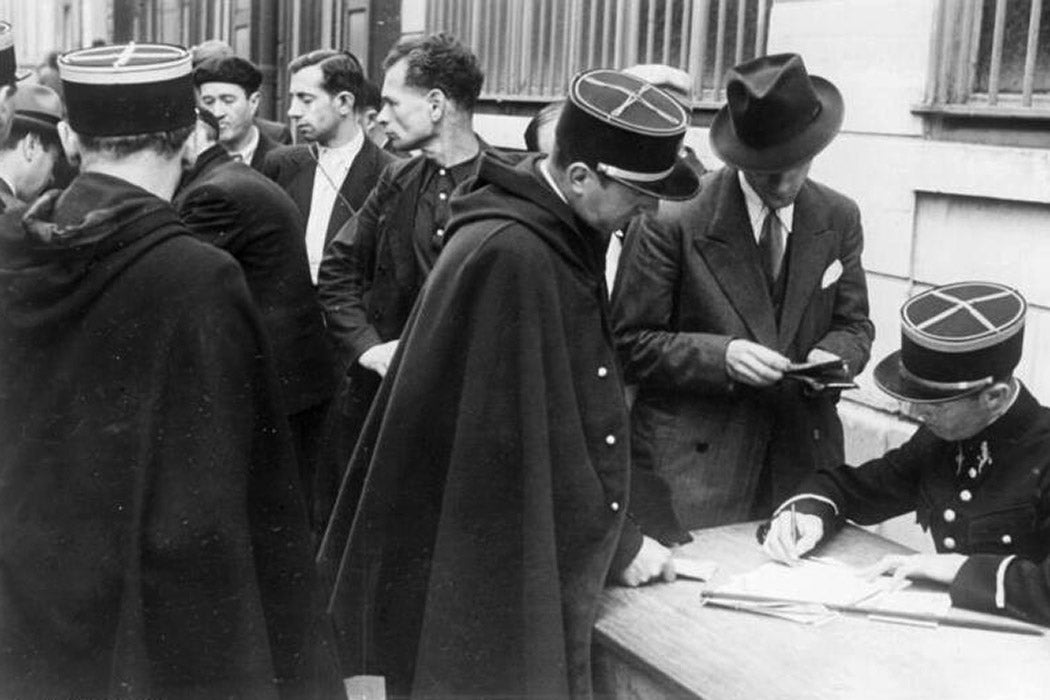
The French police arrest Jewish people on the orders of the German occupiers and take their personal details, Paris, 1941
Share
By: Matthew Wills
August 25, 2024
4 minutes
The icon indicates free access to the linked research on JSTOR.
In France during World War II, the French police had a large part in implementing the Nazi’s Final Solution. These “ordinary agents of the state,” as historian Laurent Joly calls them, arrested 38,500 of the 74,150 Jews deported from the prefecture of the Seine (Paris and its suburbs) to the murder-factories of the concentration camps. This makes the Paris part of the Shoah almost unique.

The Paris Police Prefecture was “one of France’s most prestigious institutions, founded in 1800 by Napoleon,” writes Joly. It was given a task—rounding up both French Jews and Jewish refugees—that was usually undertaken in other countries under Nazi occupation by the SS, Gestapo, or other special “parallel police forces.” In Paris, the “Gestapo made the decision to rely” on the regular police, whose “reputation for efficacy was too well established to not be respected—and used.” A German-only operation wasn’t seen as feasible for political and strategic reasons.
“Militant antisemitism and collaborationist zeal held little place within the Paris Police Prefecture. But the occupier could profit from its professional savoir-faire, from its spirit of obedience, and its allegiance to Vichy,” Joly writes.
The police carried out their orders in the “institutional logic” of bureaucracy and Vichy collaboration.
“Vichy” is the shorthand name for France under German occupation. Between July 1940 and November 1942, France was divided into two parts: a northern section occupied by the Germans and a southern section, nominally a “free zone” administered by a Nazi-approved government headquartered in the town of Vichy. Beginning in the autumn of 1940, the Vichy regime started interning refugee Jews in the unoccupied zone—internment was the first step towards the death camps. Following the Allied invasion of North Africa in November 1942, Germany and Italy occupied the southern half of France, ending any pretense of independence for the authoritarian Vichy collaborationists headed by Marshal Philippe Petain.
Although there were zealous and anti-Jewish flics, French slang for cops, on the whole the police were not as efficient as the special forces used in other occupied countries. For many of the street cops and desk-bound higher-ups, the round-ups “were a drudgery imposed [on them], and professional honor dictated that they accomplish the thankless task to the best of their abilities,” Joly explains. Some alerted Jewish friends in advance. Some were horrified but nonetheless followed orders.
Because most of the cops were bureaucrats rather than ideologues—Joly does note there was a strong stain of institutional xenophobia in the force—the round-up operations carried out by the police were uneven. Arrondissements closer to the center of Paris had proportionally fewer arrests than arrondissements farther away. Not a few targets managed to evade arrest.
“Despite the round-ups and daily arrests, so many Jews in Paris were able to escape the worst (approximately 50,000 Jews remained in the capital at the Liberation), whereas in Warsaw, Berlin, or Amsterdam, nearly all of the Jewish communities were exterminated,” Joly writes.
In all, about a quarter of the Jews counted within France in 1940–41 were sent to death. This compares with nearly 75 percent of the Jewish population of the Netherlands and 90 percent of the Polish Jewish population. Only the small Danish Jewish population largely survived German occupation—almost all of them were saved by being ferried to neutral Sweden.
Weekly Newsletter
Get your fix of JSTOR Daily’s best stories in your inbox each Thursday.
Privacy Policy Contact Us
You may unsubscribe at any time by clicking on the provided link on any marketing message.
After the Liberation, overtly collaborationist French police offers were dismissed. But many returned to policing in subsequent years. When the Paris police massacred dozens—some counts are in the low hundreds—of Algerians in October 1961, the man who ordered them into action was Maurice Papon, who had also been a high police official during the Vichy period.
Papon’s active collaboration with the SS during the Occupation didn’t hinder his post-war career in France’s Fifth Republic. In addition to overseeing torture and murder as head of the Paris police during the Algerian War (1954–1962), Papon’s post-war career also included serving as Minister of the Budget and as a Deputy in the National Assembly. His awards include the Legion of Honour, France’s highest order of merit, given him by Charles de Gaulle in 1961. Finally, in 1998 at the age of eighty-eight, Papon was found guilty of crimes against humanity for his role in the deportation of over 1,600 Jews from Bordeaux, including 130 children, to Auschwitz and other extermination camps.
Support JSTOR Daily! Join our membership program on Patreon today.

 canisgallicus
