
People leaving Sweden will exceed immigrants in 2024
Ines Eisele 20th August 2024
For the first time in decades, more people are leaving Sweden than arriving. The government explains this reversal by its restrictive migration policy.
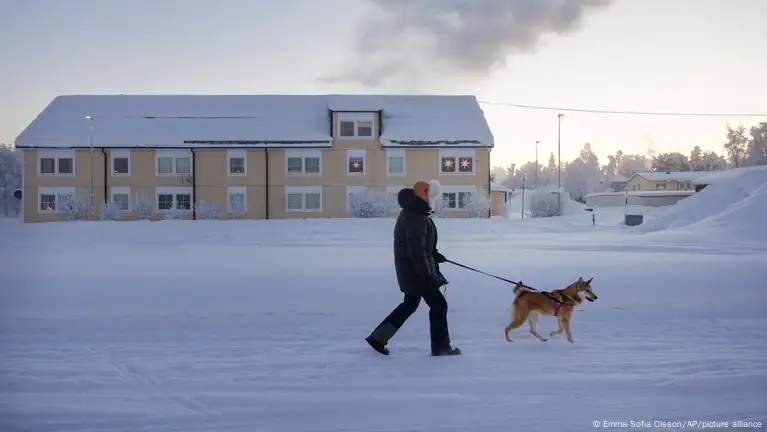
The number of immigrants in Sweden is lower than it has been for a long time.
In early August, Migration Minister Maria Malmer Stenergard said Statistics Sweden, the government’s official statistics agency, had found that 5,700 more people had emigrated than immigrated in the period from January to May 2024. Stenergard said the trend was expected to continue, adding that the number of asylum applications had not been as low since 1997.
It’s not the first time that Sweden has seen a dramatic drop in asylum applications. In 2016, 28,939 people applied for asylum in the country of just over 10.5 million— significantly down from the 162,877 applications in 2015.


Government tightened migration policies in 2016
The lower figures can be attributed to the government’s decision to change course. At the end of 2015, the ruling Social Democrats ended Sweden’s previously liberal immigration and integration policies, whereby many asylum-seekers from crisis-ridden countries such as the former Yugoslavia, Afghanistan, Syria, Iraq and Somalia had been accepted, and significantly tightened migration policies.
Since October 2022, a minority government led by conservative Prime Minister Ulf Kristersson has been in power, supported by the far-right nationalist Sweden Democrats.
In a report by the German Federal Agency for Civic Education, Swedish migration expert Bernd Parusel wrote that Sweden introduced various measures against a backdrop of major “bottlenecks in registering, finding accommodation for, and caring for asylum-seekers entering the country.”
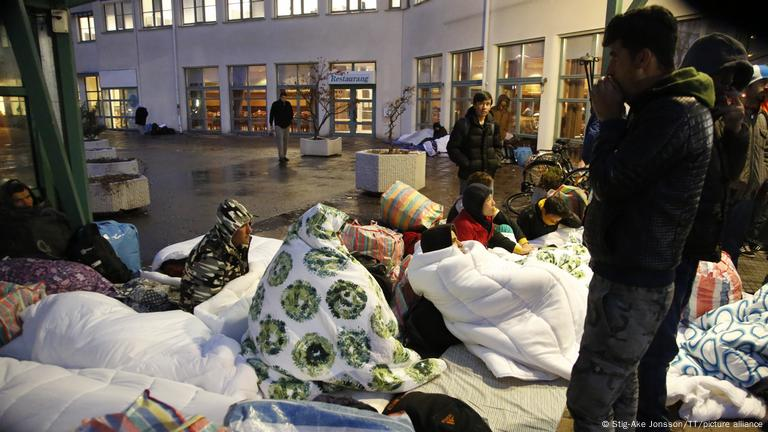

Parusel explained that the measures first concerned access to Swedish territory in order to apply for asylum. Secondly, they were about granting asylum and the legal consequences. Thirdly, the idea was that people should be encouraged to return voluntarily, and deportations should be carried out consistently.
Iraqis, Somalis and Syrians leaving Sweden
According to the Swedish government’s most recent press release, there are now more and more people who originally came from Iraq, Somalia or Syria leaving the country. It remains open how many of these voluntary returnees figure in the latest migration statistics. But Stenergard seems convinced that the current figures are down to the more restrictive policies of the past eight years. “The government’s efforts are bearing fruit,” she said.
The motives of departing immigrants also remain unclear. In 2017, Parusel explained that “making life difficult for asylum-seekers forced to leave the country” is not a suitable method of encouraging people to leave Sweden on a voluntary basis. On the contrary, he said there would be more social hardship if they were deprived of benefits and accommodation.
“The trend toward manageable immigration is crucial if we want to improve integration,” said Migration Minister Sternegard.


At first glance, it might appear logical that it’s easier to integrate migrants if there are fewer people. However, according to Parusel, the system of making Sweden as unattractive as possible for immigrants by keeping them in the dark about their prospects, while at the same time promoting better and faster integration into society, does not work.
Sweden struggling to deal with organized crime
But one sign that tougher restriction have not solved all problems is the continued problem of organized crime. Prime Minister Kristersson has set himself the goal of combating the issue, attributing it the previous government’s “irresponsible immigration policy and a failed integration.”
Sweden steps up the fight against organized crime
Indeed, Sweden has been struggling for years with criminal groups that finance themselves primarily through drug trafficking and fraud. There have been fatal shootings and bomb attacks, and also incidents of bystanders getting caught in the crossfire.
Video go to DW.

These incidents tend to take place in poorer neighborhoods, where there is a higher proportion of migrants. But experts have attributed the crime largely to high levels of unemployment, lack of prospects and poverty.
This article was originally written in German.

 canisgallicus