
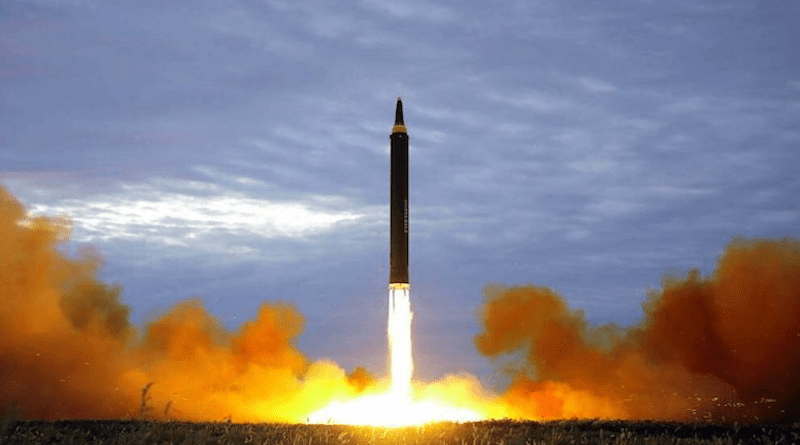
File photo of North Korea test-firing ‘Long-Range Cruise Missile’: KCNA
North Korea’s Missile Gamble: A Dangerous New Chapter In The Korean Peninsula Crisis – OpEd
The recent deployment of 250 ballistic missile launchers by North Korea on its southern border constitutes a significant escalation in its military posture, posing a tangible threat to the stability of the Korean peninsula. This development has evoked strong responses from global powers and ASEAN countries, illuminating the intricate geopolitical dynamics at play.
An analysis of the implications of this move necessitates an understanding of the historical context, concerns regarding regional stability, and international reactions, as well as the potential for diplomatic engagement and the implementation of confidence-building measures. Consequently, it is imperative to scrutinize the potential roles Indonesia and Russia might assume in the resolution of this precarious situation.
The deployment of these missile launchers, with each launcher having the capacity to accommodate four missiles, markedly bolsters North Korea’s military capabilities. Kim Jong Un’s characterizing these launchers as a “powerful treasured sword” emphasizes their strategic significance. To fully comprehend the extent of this development, one must consider the historical tensions between North and South Korea, which have been marked by sporadic escalations and a perpetual state of military readiness. In recent years, both sides have engaged in various military demonstrations, encompassing weapons trials and military drills, thereby contributing to an exceedingly volatile security environment.
The impact on regional stability should not be underestimated. The presence of such a considerable number of missile launchers near the border heightens the risk of misjudgments and inadvertent escalations. The ramifications for security extend beyond the confines of the Korean peninsula, affecting regional economies and civilian populations. The potential for military conflict, even if unintentional, could have dire consequences, disrupting economic activities and instigating a humanitarian crisis.
The reactions from major countries illustrate the global significance of this development. The United States has expressed serious concerns, considering increased military presence and strategic adjustments in the region as potential policy responses. The US’s stance is expected to involve closer military cooperation with both South Korea and Japan, both of whom face the direct threat of North Korea’s enhanced capabilities. China, as North Korea’s traditional ally, faces a delicate balancing act.
While aiming to maintain regional stability, China also seeks to avoid alienating Pyongyang. China’s diplomatic efforts may concentrate on mediation and encouraging North Korea to engage in dialogue, despite its limited influence over Kim Jong Un’s regime. Japan’s response is characterized by heightened defence preparedness and efforts to strengthen alliances with the US and South Korea. Japan perceives North Korea’s missile capabilities as a direct threat, leading to investments in missile defence systems and increased military cooperation within the region.
Russia’s role in the Korean Peninsula crisis is multifaceted. Although Russia has historically had strong ties with North Korea, its broader regional interests often require a more balanced approach. Publicly, Russia has called for restraint and diplomatic solutions, presenting itself as a potential mediator. However, it is uncertain how much its military and economic cooperation with North Korea, including the Russia-North Korea Security Agreement, can contribute to effective crisis management. This lack of clarity raises doubts about Russia’s reliability as a key player in easing tensions on the peninsula.
The response from the Association of Southeast Asian Nations (ASEAN), collectively and individually, underscores the regional concern over North Korea’s actions. ASEAN statements typically prioritize diplomacy and peaceful resolution, reflecting the association’s principles of non-interference and regional stability. Members such as Indonesia, Malaysia, and Singapore have expressed specific concerns and advocated for restraint. Indonesia, in particular, is well-positioned to play a significant role due to its diplomatic efforts within ASEAN and its historical role in mediating regional conflicts. Its involvement can be instrumental in shaping a coordinated ASEAN response that emphasizes diplomatic engagement and confidence-building measures.
To navigate this complex situation, careful attention must be given to several variables. The proliferation risk posed by military capabilities and technological advancements in missile systems could potentially trigger an arms race in the region. The political will of all parties involved is crucial, as domestic political pressures can greatly influence international actions. Economic sanctions and incentives also play a critical role, necessitating a careful assessment of the efficacy of existing sanctions on North Korea and potential economic incentives for compliance and disarmament.
In conclusion, the positioning of North Korea’s ballistic missile launchers near its southern border signifies a noteworthy escalation with extensive implications for regional stability and international relations. The responses from global powers and the ASEAN emphasize the intricate dynamics in play, where diplomatic engagement and confidence-building measures emerge as pivotal strategies for de-escalation. The capacity of Indonesia to act as a mediator and Russia’s judicious efforts at mediation offer the potential to contribute to a well-balanced and coordinated international response.
To prevent further escalation and foster long-term stability on the Korean peninsula, it is imperative to address factors such as military capabilities, political determination, and economic considerations. Recommendations encompass maintaining diplomatic engagement, strengthening defence cooperation among allies, cultivating regional dialogue through ASEAN, implementing confidence-building measures, and exploring economic incentives to encourage North Korea’s adherence to international norms.
The opinions expressed in this article are the author’s own.
References
- https://www.cfr.org/global-conflict-tracker/conflict/north-korea-crisis
- https://www.armscontrol.org/act/2024-03/features/missiles-preemption-and-risk-nuclear-war-korean-peninsul
- https://www.usmcu.edu/Outreach/Marine-Corps-University-Press/MCU-Journal/JAMS-vol-15-no-1/Kim-Jong-United
- https://www.icanw.org/nuclear_tensions_rise_on_korean_peninsula
FacebookTwitterEmailFlipboardMastodonLinkedInShare

Simon Hutagalung
Simon Hutagalung is a retired diplomat from the Indonesian Foreign Ministry and received his master’s degree in political science and comparative politics from the City University of New York. The opinions expressed in his articles are his own.
Leave a Reply
Your email address will not be published. Required fields are marked *
Comment *
Name *
Email *
Website
https://googleads.g.doubleclick.net/pagead/ads?gdpr=1&gdpr_consent=CQCkcIAQCkcIAEsACBENA_FoAP_gAEPgACiQINJB7C7FbSFCwH5zaLsAMAhHRsAAQoQAAASBAmABQAKQIAQCgkAQFASgBAACAAAAICZBIQIECAAACUAAQAAAAAAEAAAAAAAIIAAAgAEAAAAIAAACAAAAEAAIAAAAEAAAmAgAAIIACAAAhAAAAAAAAAAAAAAAAgCAAAAAAAAAAAAAAAAAAQOhSD2F2K2kKFkPCmwXYAYBCujYAAhQgAAAkCBMACgAUgQAgFJIAgCIFAAAAAAAAAQEiCQAAQABAAEIACgAAAAAAIAAAAAAAQQAABAAIAAAAAAAAEAAAAIAAQAAAAIAABEhCAAQQAEAAAAAAAQAAAAAAAAAAABAAA&addtl_consent=2~70.89.93.108.122.149.196.236.259.311.313.323.358.415.449.486.494.495.540.574.609.827.864.981.1029.1048.1051.1095.1097.1126.1205.1276.1301.1365.1415.1423.1449.1514.1570.1577.1598.1651.1716.1735.1753.1765.1870.1878.1889.1958.2072.2253.2299.2357.2373.2415.2506.2526.2568.2571.2575.2624.2677~dv.&client=ca-pub-7107515782730935&output=html&h=600&slotname=7016981075&adk=4262920103&adf=1995730936&pi=t.ma~as.7016981075&w=300&abgtt=3&lmt=1723017642&format=300×600&url=https%3A%2F%2Fwww.eurasiareview.com%2F07082024-north-koreas-missile-gamble-a-dangerous-new-chapter-in-the-korean-peninsula-crisis-oped%2F&wgl=1&uach=WyJXaW5kb3dzIiwiMTAuMC4wIiwieDg2IiwiIiwiMTI3LjAuNjUzMy44OSIsbnVsbCwwLG51bGwsIjY0IixbWyJOb3QpQTtCcmFuZCIsIjk5LjAuMC4wIl0sWyJHb29nbGUgQ2hyb21lIiwiMTI3LjAuNjUzMy44OSJdLFsiQ2hyb21pdW0iLCIxMjcuMC42NTMzLjg5Il1dLDBd&dt=1723028365243&bpp=1&bdt=870&idt=128&shv=r20240801&mjsv=m202407300101&ptt=9&saldr=aa&abxe=1&cookie=ID%3Dd16a84e16adab97b%3AT%3D1722366123%3ART%3D1722441229%3AS%3DALNI_Mb_FH99puziEcuF9Lkyqt8Cxf79Vg&gpic=UID%3D00000eaaf048a9b1%3AT%3D1722366123%3ART%3D1722441229%3AS%3DALNI_MY0u6xjTw1DiUz36K8OySHf-0s34Q&eo_id_str=ID%3Dad36b906ceea7a42%3AT%3D1722366123%3ART%3D1722441229%3AS%3DAA-AfjYLNlwBUjEq_0IhuJrUveb-&prev_fmts=0x0%2C336x280%2C336x280&nras=1&correlator=2478590380106&frm=20&pv=1&u_tz=60&u_his=2&u_h=1080&u_w=1920&u_ah=1040&u_aw=1920&u_cd=24&u_sd=1&dmc=8&adx=900&ady=323&biw=1279&bih=817&scr_x=0&scr_y=0&eid=44759876%2C44759927%2C44759842%2C44795921%2C95331688%2C95331832%2C95334526%2C95334828%2C95337870%2C95335246%2C31084184%2C95339232%2C95336266%2C21065725%2C31078663%2C31078665%2C31078668%2C31078670&oid=2&pvsid=1914440137418209&tmod=162122010&uas=0&nvt=1&ref=https%3A%2F%2Fapi.follow.it%2F&fc=1920&brdim=33%2C93%2C33%2C93%2C1920%2C0%2C1312%2C946%2C1296%2C817&vis=1&rsz=%7C%7CeE%7C&abl=CS&pfx=0&fu=0&bc=31&bz=1.01&td=1&tdf=2&psd=W251bGwsbnVsbCxudWxsLDNd&nt=1&ifi=4&uci=a!4&fsb=1&dtd=299
Search
Hasina-Yunus Conflict: An Illustration Of A Dictator’s Paranoia – Analysis
Persecuted Nobel Laureate Dr. Muhammad Yunus has been chosen to Head the Interim Government of post-Hasina Bangladesh Dr. Muhammad Yunus,
https://googleads.g.doubleclick.net/pagead/ads?gdpr=1&gdpr_consent=CQCkcIAQCkcIAEsACBENA_FoAP_gAEPgACiQINJB7C7FbSFCwH5zaLsAMAhHRsAAQoQAAASBAmABQAKQIAQCgkAQFASgBAACAAAAICZBIQIECAAACUAAQAAAAAAEAAAAAAAIIAAAgAEAAAAIAAACAAAAEAAIAAAAEAAAmAgAAIIACAAAhAAAAAAAAAAAAAAAAgCAAAAAAAAAAAAAAAAAAQOhSD2F2K2kKFkPCmwXYAYBCujYAAhQgAAAkCBMACgAUgQAgFJIAgCIFAAAAAAAAAQEiCQAAQABAAEIACgAAAAAAIAAAAAAAQQAABAAIAAAAAAAAEAAAAIAAQAAAAIAABEhCAAQQAEAAAAAAAQAAAAAAAAAAABAAA&addtl_consent=2~70.89.93.108.122.149.196.236.259.311.313.323.358.415.449.486.494.495.540.574.609.827.864.981.1029.1048.1051.1095.1097.1126.1205.1276.1301.1365.1415.1423.1449.1514.1570.1577.1598.1651.1716.1735.1753.1765.1870.1878.1889.1958.2072.2253.2299.2357.2373.2415.2506.2526.2568.2571.2575.2624.2677~dv.&client=ca-pub-7107515782730935&output=html&h=200&adk=1862405480&adf=2032773826&pi=t.aa~a.3501261967~rp.4&w=310&abgtt=3&fwrn=1&fwrnh=100&lmt=1723017642&rafmt=1&to=qs&pwprc=1817506225&format=310×200&url=https%3A%2F%2Fwww.eurasiareview.com%2F07082024-north-koreas-missile-gamble-a-dangerous-new-chapter-in-the-korean-peninsula-crisis-oped%2F&fwr=0&fwrattr=false&pra=3&rpe=1&resp_fmts=3&wgl=1&fa=40&uach=WyJXaW5kb3dzIiwiMTAuMC4wIiwieDg2IiwiIiwiMTI3LjAuNjUzMy44OSIsbnVsbCwwLG51bGwsIjY0IixbWyJOb3QpQTtCcmFuZCIsIjk5LjAuMC4wIl0sWyJHb29nbGUgQ2hyb21lIiwiMTI3LjAuNjUzMy44OSJdLFsiQ2hyb21pdW0iLCIxMjcuMC42NTMzLjg5Il1dLDBd&dt=1723028366116&bpp=4&bdt=1744&idt=4&shv=r20240801&mjsv=m202407300101&ptt=9&saldr=aa&abxe=1&cookie=ID%3Dd16a84e16adab97b%3AT%3D1722366123%3ART%3D1722441229%3AS%3DALNI_Mb_FH99puziEcuF9Lkyqt8Cxf79Vg&gpic=UID%3D00000eaaf048a9b1%3AT%3D1722366123%3ART%3D1722441229%3AS%3DALNI_MY0u6xjTw1DiUz36K8OySHf-0s34Q&eo_id_str=ID%3Dad36b906ceea7a42%3AT%3D1722366123%3ART%3D1722441229%3AS%3DAA-AfjYLNlwBUjEq_0IhuJrUveb-&prev_fmts=0x0%2C336x280%2C336x280%2C300x600&nras=2&correlator=2478590380106&frm=20&pv=1&u_tz=60&u_his=2&u_h=1080&u_w=1920&u_ah=1040&u_aw=1920&u_cd=24&u_sd=1&dmc=8&adx=900&ady=1603&biw=1279&bih=817&scr_x=0&scr_y=0&eid=44759876%2C44759927%2C44759842%2C44795921%2C95331688%2C95331832%2C95334526%2C95334828%2C95337870%2C95335246%2C31084184%2C95339232%2C95336266%2C21065725%2C31078663%2C31078665%2C31078668%2C31078670&oid=2&pvsid=1914440137418209&tmod=162122010&uas=0&nvt=1&ref=https%3A%2F%2Fapi.follow.it%2F&fc=1920&brdim=33%2C93%2C33%2C93%2C1920%2C0%2C1312%2C946%2C1296%2C817&vis=1&rsz=%7C%7Cs%7C&abl=NS&fu=128&bc=31&bz=1.01&td=1&tdf=2&psd=W251bGwsbnVsbCxudWxsLDNd&nt=1&ifi=5&uci=a!5&btvi=3&fsb=1&dtd=10

North Korea’s Missile Gamble: A Dangerous New Chapter In The Korean Peninsula Crisis – OpEd

The UN’s Call To Sanctions Taliban – OpEd

Ukraine And The Frontlines Of The War On Disinformation – Analysis
 Patial RC on Conflict Mediation With Chinese Characteristics: Evaluating Beijing’s Role As Peace-Broker – AnalysisAugust 7, 2024China on its own is projecting itself as a peace mediator! For China the first and foremost, interest is preserving…
Philip on Washington’s Plan To Break Up Russia – OpEdAugust 5, 2024The US plan to break up Russia, that only Putin can prevent… Yet elsewhere you at Eurasia Review call him…
- PATIAL RC on The Biden Report: No Wars To Be Seen – OpEdAugust 3, 2024President Biden and a few Senators view; “No Americans are getting killed in Ukraine. We are rebuilding our industrial base…The…
raj on Jaishankar’s Diplomatic Duplicity At Astana – OpEdAugust 1, 2024By sponsoring terrorism, especially against India, Pakistan has enmeshed itself in deep economic and security problems. It is unable to…
Copyright Eurasia Review. (ISSN 2330-717X) All rights are reserved.Follow us on: Mastodon

 canisgallicus