
Memory for music doesn’t diminish with age
Eighty-year-olds are able to identify familiar tunes just as well as teenagers can.
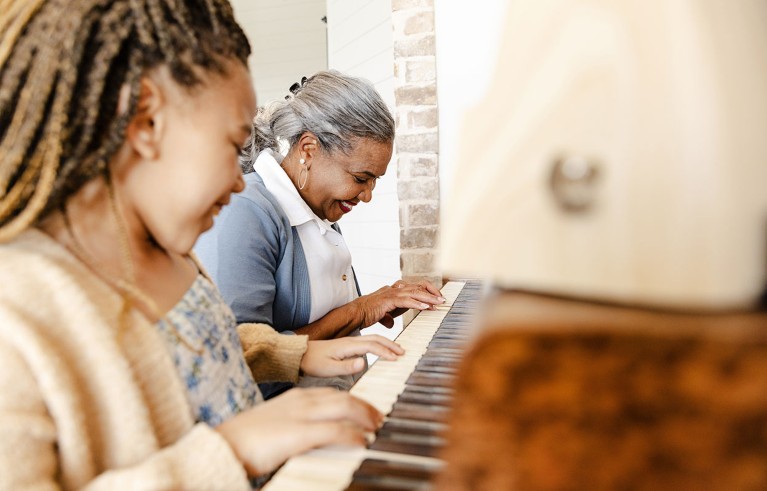
The ability to remember and recognize a musical theme does not seem to be affected by age, unlike many other forms of memory.
“You’ll hear anecdotes all the time of how people with severe Alzheimer’s can’t speak, can’t recognize people, but will sing the songs of their childhood or play the piano,” says Sarah Sauvé, a feminist music scientist now at the University of Lincoln in the United Kingdom.
Past research has shown that many aspects of memory are affected by ageing, such as recall tasks that require real-time processing, whereas recognition tasks that rely on well-known information and automatic processes are not. The effect of age on the ability to recall music has also been investigated, but Sauvé was interested in exploring this effect in a real-world setting such as a concert.
In her study1, published today in PLoS ONE, she tested how well a group of roughly 90 healthy adults, ranging in age from 18 to 86 years, were able to recognize familiar and unfamiliar musical themes at a live concert. Participants were recruited at a performance of the Newfoundland Symphony Orchestra in St John’s, Canada. Another 31 people watched a recording of the concert in a laboratory.
The study focused on three pieces of music played at the concert: Eine kleine Nachtmusik by Mozart, which the researchers assumed most participants were familiar with, and two specially commissioned experimental pieces. One of these was tonal and easy to listen to; the other was more atonal and didn’t conform to the typical melodic norms of Western classical music. A short melodic phrase from each of the three pieces was played three times at the beginning of that piece, and participants then logged whenever they recognized that theme in the piece.
The melodic phrase from the Eine kleine Nachtmusik was equally well recognized across all ages and musical backgrounds, with no loss of recognition as age increased. All participants were less confident in recognizing the theme in the unfamiliar tonal piece, and even less confident with the unfamiliar atonal piece. This pattern, too, did not vary with age. The study also found no age-related difference in the results between the participants at the concert and those in the lab.
Steffen Herff, a cognitive neuroscientist at the University of Sydney, Australia, says the reason musical memory seems to be resistant to age-related cognitive declines might have to do with the emotions that music stirs in people, which makes it more encoded in memory. “We know from general memory research that, effectively, the amygdala — or emotional processing — operates a little bit like an importance stamp,” he says.
Music also tends to follow certain rules, so “it’s relatively easy to have a pretty good guess of what happened in-between,” Herff says.
The study collected limited data on some participants’ cognitive health, and so did not provide detailed insights into how cognitive impairments or neurodegenerative diseases affect memory recall. But Herff says there is great interest in using music as a form of ‘cognitive scaffolding’ — that is, as a memory aid for other information — in individuals with neurogenerative conditions such as dementia.
doi: https://doi.org/10.1038/d41586-024-02369-7

 canisgallicus