
From Gamification to Game-Based Learning
Use the JSTOR Daily Sleuth game to highlight the dangers of AI within academic research.

Share
By: Fiona Warburton
July 23, 2024
4 minutes
The icon indicates free access to the linked research on JSTOR.
There’s no escaping talk of AI and its burgeoning capabilities, as artificial intelligence now permeates all aspects of life, streamlining both simple administrative tasks and the painstaking process of researching something on the internet. But when it comes to academia, concerned as it is in the pursuit of research, education, and scholarly activity, AI offers new tools and approaches for literature searching, content analysis, report writing, and other academic processes.

There’s been heated debate amongst academics about the challenges that AI poses to staff and students in higher education in terms of academic integrity and the potential for AI-assisted “cheating”. This has led universities worldwide hurrying to rewrite policies which incorporate the new set of ethical responsibilities that AI brings to the research process and to assessment. In the United Kingdom, new declarations of authenticity are signed by students to declare their use of specific AI tools in planning, preparing, or writing parts of their research projects or evidence for assessment.
As a member of staff working in dual roles in a higher education institution in the UK, (teaching within faculty for two days a week and working in the university’s library learning and teaching team the rest of the week), it’s clear to me that students aren’t offered the same transparency about AI-generated content for the information sources they access when carrying out research. University students have been using tools such as the CRAAP test, RADAR, and the 5 Ws for decades to evaluate sources of information and, more recently, to root out potential items of fake news. But can they use these tools successfully to detect AI-generated research articles amongst the proliferation of real academic research at the touch of a button?
Raising awareness of the existence of AI-generated research has presented academic libraries with a new information literacy agenda. Enter the JSTOR Daily Sleuth—a game that tests your ability to detect whether the title of an academic research paper is authentic or generated by AI. Each day, five new journal article titles are shared within the game, and you try and work out which four are AI -generated, and which one is real.
Steven Chopade describes how gamification can be used within eLearning to improve knowledge retention. A gamification strategy involves the use of unique gaming techniques and elements to increase the learner’s participation and stimulate their interest. Gamification involves elements such as badges, levels, and leader boards to create an interactive experience that encourages learners to take part and achieve specific goals. Game-based learning embeds a game into teaching so that the game itself becomes the learning, that is to say, there are defined learning outcomes attached to playing a game.
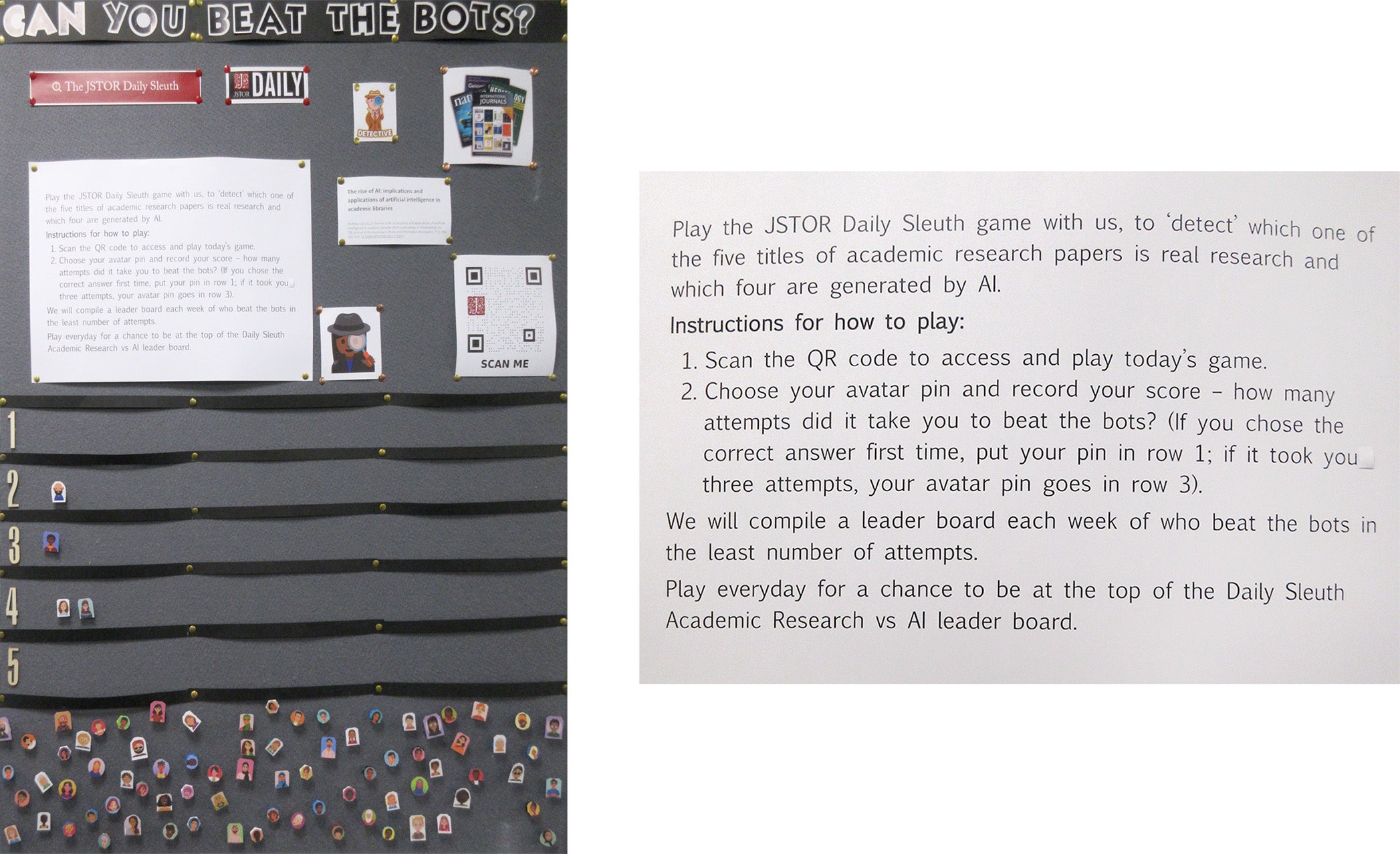
In April 2024, one of the site libraries at my university installed an interactive display called “Can You Beat the Bots?” incorporating the JSTOR Daily Sleuth game. A trackable QR takes the player directly to the game each time it’s scanned. Avatar pins are provided, along with a set of instructions and a leader board grid, so that players can record their score each day—to show whether they found the real title amongst the four AI-generated titles at first, or at fifth, attempt. The library staff keeps a record of the number of unique scans made and of the leader board each week. Only those library users who want to play do so.
Weekly Newsletter
Get your fix of JSTOR Daily’s best stories in your inbox each Thursday.
You may unsubscribe at any time by clicking on the provided link on any marketing message.
By May 2024, a move away from gamification and towards game-based learning was made at another of the site libraries. The QR code was incorporated into the library induction for a new cohort of international postgraduate students at the university’s Business School. More than a hundred unique scans were made that day, with many repeat plays in the weeks that followed.
The next step for the inclusion of the Daily Sleuth as an integral part of information literacy learning has already been made. From September 2024, the university will incorporate the same trackable QR code within its Moodle module library learning page so that all first-year undergraduate students can take on beating the bots by becoming daily sleuths themselves, learning how to spot real research amongst a sea of AI-generated research articles.
In addition to this, the Daily Sleuth will take its place in game-based learning beyond the library with plans to integrate the game within faculty-led teaching before the end of 2024. Can you beat the bots? Why not take on the challenge and become a JSTOR Daily Sleuth yourself.
Support JSTOR Daily! Join our membership program on Patreon tod

 canisgallicus