Iran: ‘Western pressure can hinder executions’
Shabnam von Hein05/29/2024May 29, 2024
At least 853 people were executed in Iran last year. Human rights activists suspect the number was actually much higher and are calling for pressure to be brought to bear on leaders in Tehran.
Copy link
Advertisement
According to the latest “Death Sentences and Executions” report released by the human rights organization Amnesty International
(AI), at least 1,153 people were executed worldwide in 2023. Amnesty says that is the highest number it has documented since 2015, adding that nearly three-quarters of those executions took place in Iran.

Amnesty International’s latest report claims that the authorities in Iran are increasingly using capital punishment as a way to terrorize citizensImage: Stéphane Lelarge/Amnesty International
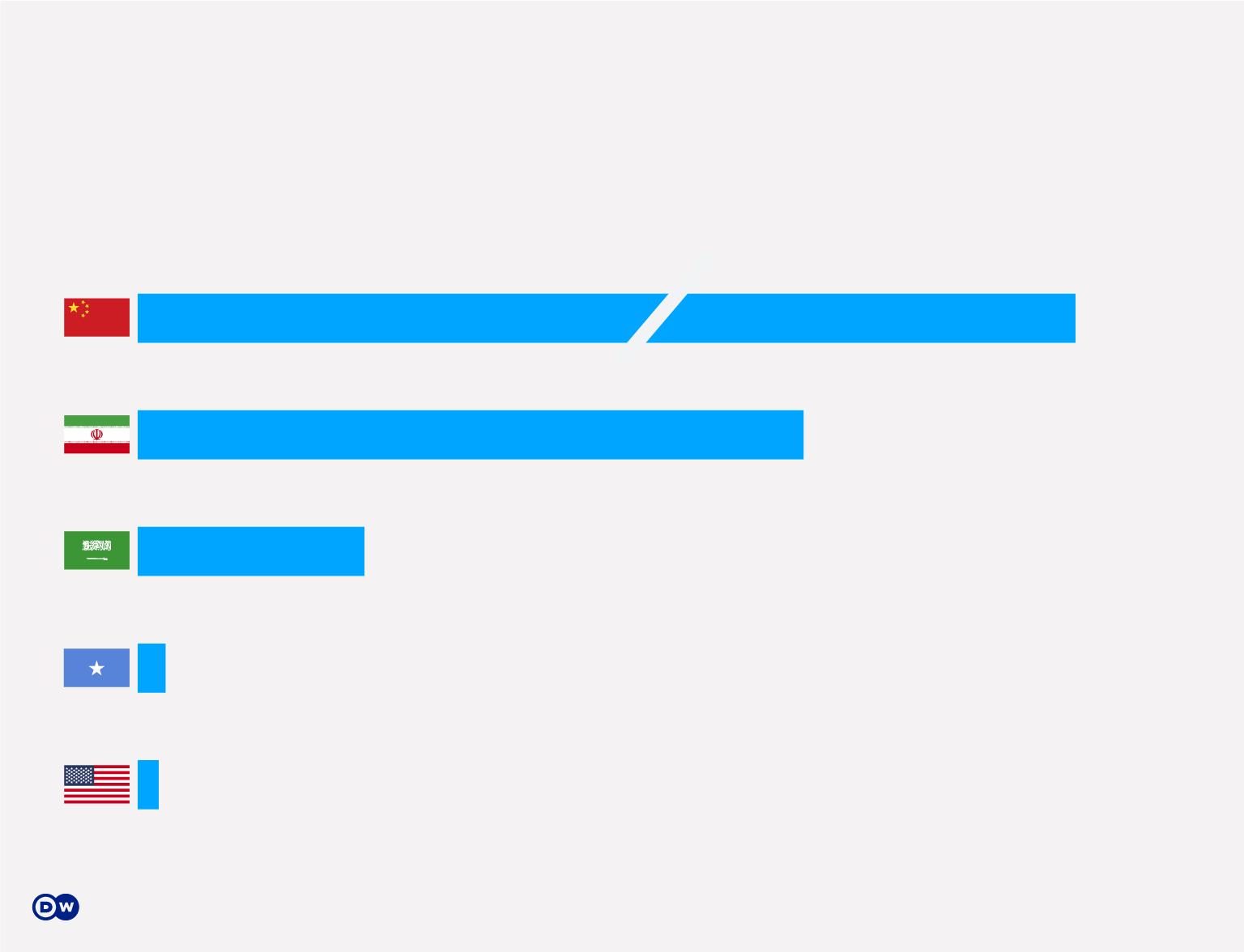
The thousands of executions that likely took place in China last year were not included in the AI report’s statistics. Nor were those in Vietnam and North Korea, where AI suspects large numbers of executions were carried out. Most of the world’s executions, says Amnesty, took place in China (thousands), Iran (at least 853) and Saudi Arabia (172).
“In Iran, the number of death sentences handed down and carried out for both political and non-political reasons rose significantly,” as Rebin Rahmani, a Kurdish activist based in Paris told DW. Rahmani works with the France-based Kurdistan Human Rights Network (KHRN), which collects and verifies information on human rights violations in Iran.
The Iranian judiciary’s use of intimidation
https://static.dw.com/image/63392053_605.webp
Death penalty ‘main instrument for creating fear’
“Twenty-nine Kurdish prisoners have been executed in the past four weeks alone,” says Rahmani, adding: “Among them was Khosro Besharat, a political prisoner who was arrested 14 years ago. At the time, he and five other Sunni Kurds were convicted of ‘crimes on earth’ and sentenced to death. Their executions were carried out over the past few months.”
Besharat and his compatriots were accused of having killed a Shiite cleric in December 2009. The investigation dragged on due to lack of evidence.
In 2018, Besharat’s mother penned an open letter to Javaid Rehman, the UN’s special rapporteur on the situation of human rights in the Islamic Republic of Iran, to register her complaint against the Iranian judiciary. She wrote at the time that there was no evidence against her son, who had been jailed for nearly 10 years. The only thing the Iranian judiciary had was a forced confession, she said.
Amnesty International’s latest report claims that the authorities in Iran are increasingly using capital punishment as a way to terrorize citizens and cement their own power. Executions this year were considerably higher than last: In 2022, Amnesty counted 576 executions. That number rose to 853 in 2023, a 48% jump.
https://www.dw.com/webapi/iframes/widget/en/69212824
Executions often carried out in secret
In 2022, after conducting sham trials, Iran executed nine people in connection with the “Woman, Life, Freedom” protests that rocked the country in the wake of the death of Mahsa Amini at the hands of police. “Without international pressure, that number would have been considerably higher,” Mahmood Amiry-Moghaddam, director of the Norway-based organization Iran Human Rights (IHR), told DW.
Iran Human Rights has been observing and publishing reports on capital punishment in the Islamic Republic since 2007.
“The global outrage that followed the execution of each jailed protester, and the corresponding measures that followed each — such as the sanctions imposed by the EU — were effective, and delayed executions. Though that doesn’t mean they won’t eventually be carried out. At the same time, the number of executions carried out for other crimes, such as drug convictions, has risen substantially,” said Amiry-Moghaddam.
Executions for drug convictions are often carried out in secret, without the knowledge of a prisoner’s family or legal counsel. In November 2023, for instance, brothers Saeed andIsmail Alizahi were executed in the city of Zahedan on drug charges without either receiving a final visit from their family.
Scared into silence
“We also have a list with the names of 47 more individuals who were executed over the past 12 months,” said Amiry-Moghaddam. “But we have yet to publish their names because have not been able to find a second independent source to confirm their execution.”
Not every family speaks up and informs human rights organizations in such situations. Many survivors remain silent out of fear for their safety, or out of shame.
Amnesty International says that 60% of all documented executions in Iran are carried out for crimes that are not punishable by death according to international law, above all, for drug crimes. Those executions affect the ethnic Baloch minority more than any other group. Although they only make up about 5% of the Iranian population, the Baloch account for 20% of the country’s documented executions.
Iran’s trend of increasingly high numbers of executions also appears to be continuing in 2024: By March 20, some 95 executions were documented in the country. At least eight people jailed for participating in the Woman, Life, Freedom protests are currently on death row in the Islamic Republic.
This article was translated from the German by Jon Shelton.
https://static.dw.com/image/66100862_605.webp
Brutal cost of protest in Iran
Send us your feedback
Your feedbackSkip next section Explore more
Explore more
Amnesty International report
www.amnesty.orgSkip next section Related topics
Related topics
Iran protestsDeath penaltyJina Mahsa AminiEbrahim RaisiAmnesty InternationalIranSkip next section DW’s Top Story

 canisgallicus