Some 44% of workers say they feel stressed, a record high figure that suggests burnout is not a psychological problem but rather a structural one
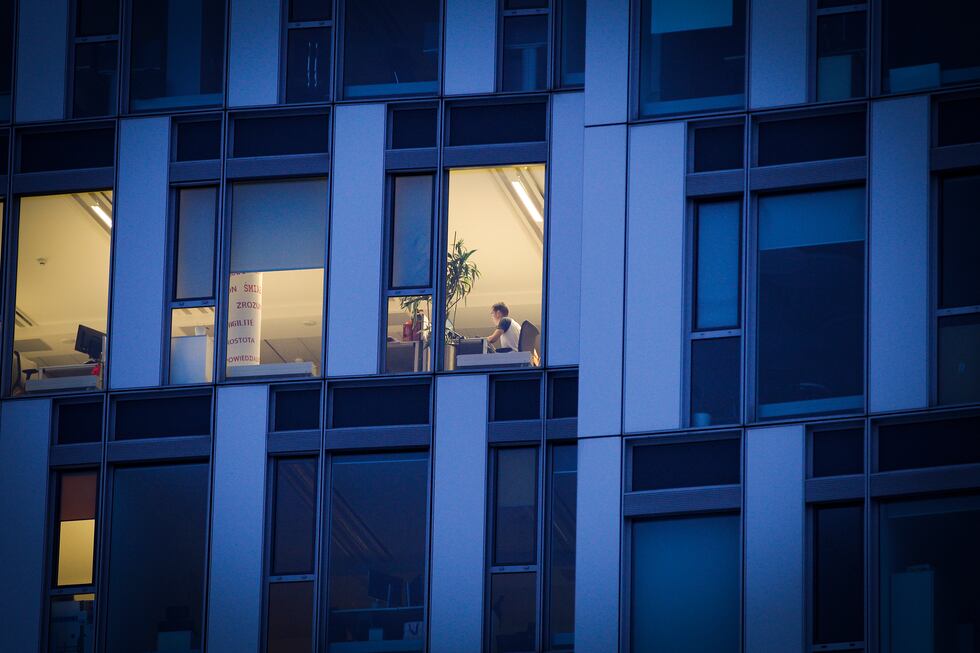
Workers in the offices of a company in Poland. Jaap Arriens (NurPhoto/ Getty Images)

Madrid – May 28, 2024 – 19:53 CEST
Beatriz Serrano was locked in her home, like half the world, due to Covid-19 restrictions. She couldn’t meet her friends or go for a walk, but she had to work at an exhausting pace. After a video conference, she went out to a small interior courtyard, and heard the silence: “I remembered all the stories I had heard about the end of the world, from H.G. Wells’ aliens to the Mad Max water wars, and I thought: ‘Wow, it seems like it’s the end of the world, and it’s going to catch us working,’ explains Serrano, who worked in the communication sector.
She found that depressing, but also inspiring, so she began to write about the experience. It was the seed of El Descontento (The Discontent), a novel about disillusionment and capitalist work culture. The book was published a few months ago and has become a small publishing phenomenon (with translations underway in Italy, France, England and the U.S.). The author attributes its success to the fact that the story of Marisa, her protagonist, is the story of many people. It’s the story of the Serrano, who left her job and today is a writer and journalist at EL PAÍS. And that of many readers. “Many people write to me to tell me that they identify with it. It’s not that they tell me ‘I am Marisa,’ it’s that they tell me ‘we are all Marisa’,” she says.
Writer and computer scientist Cal Newport has called it The Great Exhaustion, describing a society where everyone is tired, burned out, and feeling that they cannot survive. Against this backdrop, people are seeking to redesign their relationship with work and prioritize their personal lives — a trend confirmed by a recent 40dB survey for EL PAÍS. In this survey, respondents were given seven options and asked to rank them from most important to least. The first was mental health, followed by family and having free time. Having a good job was ranked in fourth place, and having a good economic level in seventh.
If burnout syndrome reflected an individual phenomenon, The Great Exhaustion points to the collective problem behind it. Culture and the internet have played a crucial role in spreading this idea, appearing in memes, literature and music. Serrano’s book is a good example. “For me there are two key moments to understand all this. One was the [financial] crisis of 2008, which forced us to find a way to make ends meet. And another was the pandemic, which forced us to bring our lives to a halt,” explains the author. When life when back to normal, something had broken. The world forced people to resume heir previous rhythm, but many people simply did not want to.
This led to several social phenomona related to work. The first was The Great Resignation, when 47 million people voluntarily left their jobs in the U.S. alone, according to the Department of Labor. Then there were union struggles for remote working and more work-life balance. Finally, last year people began to talk about quiet quitting: working just enough, without doing overtime or putting in extra effort. A paradigm shift began to take shape.
But the workplace did not adapt. The nature of the workplace, however, did undergo important changes during the pandemic. In the first few months, there was an exponential increase in digital communications: Zoom and Slack became a lifeline amid the work tsunami. The use of these platforms increased by 350% and 400% respectively. It became normal to use more informal communication channels such as WhatsApp to discuss work issues. And so, work began to seep into workers’ homes and private lives. Technology helped blur the borders between both worlds.
After the pandemic, workers returned to the office, but the amount of digital communication remained the same. According to a Microsoft report, time spent in online meetings increased more than 350% between February 2020 and 2022. Users of the Microsoft Office suite now spend about 60% of their time using digital communication tools — email, chat and video conferencing—, and the remaining 40% to creation programs, such as Word, Excel and PowerPoint. One in four workers spends nine hours a week on email alone. Almost two in three people (64%) say they have difficulty finding the time and energy they need to do their work, according to this report.
The problem with this new reality is that the rise in digital communication is associated in research with a fall in satisfaction. And this is reflected in the numbers. The latest report from the Gallup consulting firm on employment, published in 2023, provided historical data: 44% of workers felt stressed. The figures are unprecedented and can’t be explained just by the greater use of email. For Yolanda García Rodríguez, professor in the department of Social, Work and Differential Psychology at the Complutense University of Madrid, “work demands are now greater. The complexity of the tasks is greater, the qualifications required in jobs are increasing. Very quick decision-making, continuous and rapid adaptation to new technologies and greater competition and productivity are required.”
On the other hand, successive crises, unstable work conditions and precarious jobs have created a volatile environment that has helped change how workers think about their relationship with their employers. “Workers’ job expectations and their level of job self-esteem are stymied. Syndromes such as imposter syndrome have emerged and the probability of emotional exhaustion or burnout syndrome has risen,” explains the expert. Jobs are no longer what they were, so neither are our relationships with them.
To retain a worker, companies have chosen to create a new narrative that sees work not only as a way to earn money, but also to gain status. “Suddenly, jobs are exciting, they define us, they fulfill our dreams,” says Juan Evaristo Valls Boix, professor of Philosophy of Culture at the Complutense University of Madrid. “All these team-building practices are emerging, the mantra is that in this job we are like a family,” he adds. And so, in our private lives, we begin to imitate a business mindset.
When leisure is also tiring
The Great Exhaustion starts at work, but it also transcends it. Terms such as burnout — traditionally associated with work — have begun to be applied to parenting in recent years. According to a report from Ohio State University, 66% of working parents reported being burned out. Exhaustion is beginning to spill over into other social spheres such as leisure. Meeting up with friends has to be planned weeks in advance, everyone is exhausted and no one has time.
Valls Boix says that this is because “the capitalist logic of work, that is, of investment and profit, is expanding and saturating other spheres of life.” The philosopher believes that we have become small entrepreneurs of our free time. There is a cult of productivity that begins in the office, but permeates our private lives. “A kind of overlap has been happened between the logic of work and the affective space and emotions,” he explains. Friends are seen as social capital, dating as job interviews, with dating apps operating as castings and social networks that push us to create content to boost our personal brand.
Leisure is no longer about doing nothing, but rather about filling our scarce free time with experiences: reading the books that need to be read, watching the series that are being talked about, going to the trendiest party or trying the latest viral restaurant, if you manage to get a reservation. “This is the most perverse part,” says Valls Boix. “We are not working, but we continue with the work dynamic.” This leads to a stressed-out society, where even leisure is no longer about relaxation and disconnecting. WhatsApp audios and TV series are played at 2x speed, hobbies are monetized and syndromes such as FOMO become a problem. A culture that glorifies being always busy is starting to form: hustle culture. “We live in constant excitement, overstimulated, and that can be frustrating and exhausting,” says Valls Boix.
In this way, not only work, but also leisure can also lead to the feeling of exhaustion. According to a recent report from the International Monetary Fund (IMF), the number of hours worked has fallen by 3.8% compared to 2008. The OECD also indicated in different reports that, in recent decades, effective working hours have decreased by gradually.
We work less, but we are more tired. This apparent paradox has sparked the interest of experts and social psychologists, who are investigating the dynamics that influence our perception of time. Hal E. Hershfield is one of them. This professor of Marketing and Behavioral Decision Making at the University of California, author of the essay Your Future Self, believes that the problem is not so much about quantity, but rather quality. “Actually, I think we have a lot more time. But what do we use it for? If we spend it on the phone, watching TV or doing things without meaning or purpose, I don’t see how it will benefit us.”
To investigate this idea, Hershfield conducted a macro study with data from 35,000 people. The research analyzed whether there was a direct relationship between the amount of free time a person has and their subjective well-being. The expert and his colleagues found that having little free time leads to increased stress and discomfort. It wasn’t a big surprise. More striking was the realization that having too much time is not positive either. There is an exact point of free time, around five hours a day, after which unease begins to rise. Although this discomfort was reduced if free time was filled with social activities.
In the classic 1930 essay Economic Possibilities of Our Grandchildren, John Keynes predicted a 21st century with a 15-hour work week. It seems that the economist missed the mark, but in that text, he shared a reflection that can be applied to the current context: “There is no country and no people, I think, who can look forward to the age of leisure and of abundance without a dread. For we have been trained too long to strive and not to enjoy.” This idea, expressed almost a century ago, may be at the root of what has come to be called The Great Exhaustion. Work continues to be at the center of society, of conversations, of cities. And although many people have rethought their relationship with it, work dynamics have permeated every corner of our lives. Technological advances have helped streamline work and delocalize it, but they are blurring the boundaries between work and personal life, creating a perpetual state of connectivity. This can be stimulating. But it is also exhausting.
Sign up for our weekly newsletter to get more English-language news coverage from EL PAÍS USA Edition
More information
How to deal with parental burnout
Carolina Pinedo | Madrid
In this company, we are family: The dark side of team building
MAR CARMENA

 canisgallicus