
05-21-2024 TECH
Khan Academy and Microsoft are teaming up to give teachers a free AI assistant
AI assistant Khanmigo can help time-strapped teachers come up with lesson ideas and test questions, the companies say.
[Photo: Maskot/Getty Images]
BY Steven Melendez4 minute read
Khan Academy’s AI assistant will now be free to K-12 teachers in the U.S., thanks to a new deal with Microsoft, the companies said Tuesday during Microsoft’s Build conference.
Microsoft is donating access to its Microsoft Azure infrastructure to give teachers free use of the tool, which previously required a $4 per month subscription to pay for the cost of the underlying AI service.
“They just have a very long reputation now of very successfully delivering these educational materials to learners everywhere in the world,” says Kevin Scott, Microsoft’s CTO and EVP of AI, referring to Khan Academy.
The education nonprofit, known for years for its acclaimed educational videos, will continue to charge school districts and other users for student access to the AI system, though Khan says the organization continues to search for ways to lower prices.
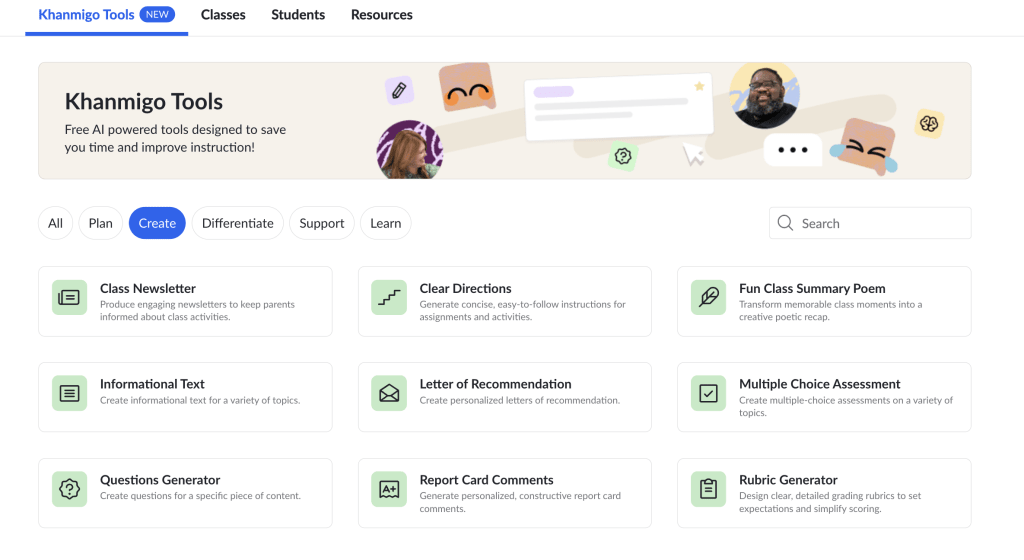
Khan Academy’s AI assistant, Khanmigo, has earned praise for helping students to understand and practice everything from math to English, but it can also help teachers devise lesson plans, formulate questions about assigned readings, and even generate reading passages appropriate for students at different levels. More than just a chatbot, the software offers specific AI-powered tools for generating quizzes and assignment instructions, drafting lesson plans, and formulating letters of recommendation.
“This is something that hopefully a teacher, within hours of using it, is already starting to see a huge ROI,” says Khan Academy founder and CEO Sal Khan.
In announcing the deal, the companies pointed to examples of teachers who’ve successfully used the software to come up with colorful analogies to make abstract science topics stick—like comparing particles in chemical reactions to dancers changing partners—and adjust reading practice passages to include vocabulary at an appropriate level.
Having a virtual teaching assistant is especially valuable in light of recent research from the RAND Corporation that found teachers work longer hours than most working adults, which includes administrative and prep work outside the classroom. Long hours relative to pay can lead to teacher burnout and cause educators to leave the profession, which means students lose the benefit of their experience, according to the report. Khan Academy’s teacher tools can help reduce the amount of time teachers have to spend getting those lessons ready.
“We are hoping that 10 to 20 hours can look a lot more like one to five hours,” says Khan.
Generative AI’s rapid growth initially brought anxiety to the world of education, with teachers from elementary school to the college level concerned about students simply having the software do their homework for them. But even beyond helping teachers, organizations including Khan Academy have increasingly honed AI-powered tools that function more like a human tutor, patiently walking students through solving a problem or offering tips for tightening up an essay without actually doing the assignment.
“They don’t make you feel bad about asking dumb questions,” says Microsoft’s Scott. “Whenever your curiosity arises, if it’s at all hours of the night or in the morning, they’re there for you.”
Scott, who grew up in pre-online rural Virginia and recalls having to seek out information and guidance, sees how AI is already giving an edge to younger generations: His daughter, a high school freshman with an interest in biochemistry, is able to use ChatGPT to help understand research papers from the field.
“Even though no one was targeting a 15-year-old when they were writing this material, she can make it accessible to herself with a free tool,” he says.
Microsoft and Khan Academy will also be working together developing AI tutoring tools for math, an area where generative AI has often struggled. The software will be powered by Microsoft’s Phi-3 small language models. As the name suggests, small language models are more compact and less computationally intensive than large language models like GPT-4, which means they can be cheaper to use and can potentially even be run on local devices instead of in the cloud.
“If that means that more kids can have access to the product, then that’s a thing really, really, really worth exploring,” says Scott.
Small language models can also require fewer resources to fine-tune them for a specific purpose, he says. And Khan Academy is providing sample educational content like math problems and detailed answers to help the models get better at math. Microsoft has already fine-tuned the current version of Phi-3 to call external code when it needs to do calculations it can’t do directly and reports the AI can already generate math problems for specific topics at specific grade levels and walk students through explanations.
Khan Academy user data won’t be used to train the models, the organizations say.
Microsoft will also incorporate more material from Khan Academy into its own AI tools, ready to be surfaced when users ask questions where it can provide educational value.
“If a student wants to learn something, and they’re asking the AI for that help, I think it is much healthier for that AI to slip in Khan Academy content than not,” says Khan.
Recognize your brand’s excellence by applying to this year’s Brands That Matter Awards before the final deadline, June 7.
Sign up for Brands That Matter notifications here.


 canisgallicus