May 10, 2024
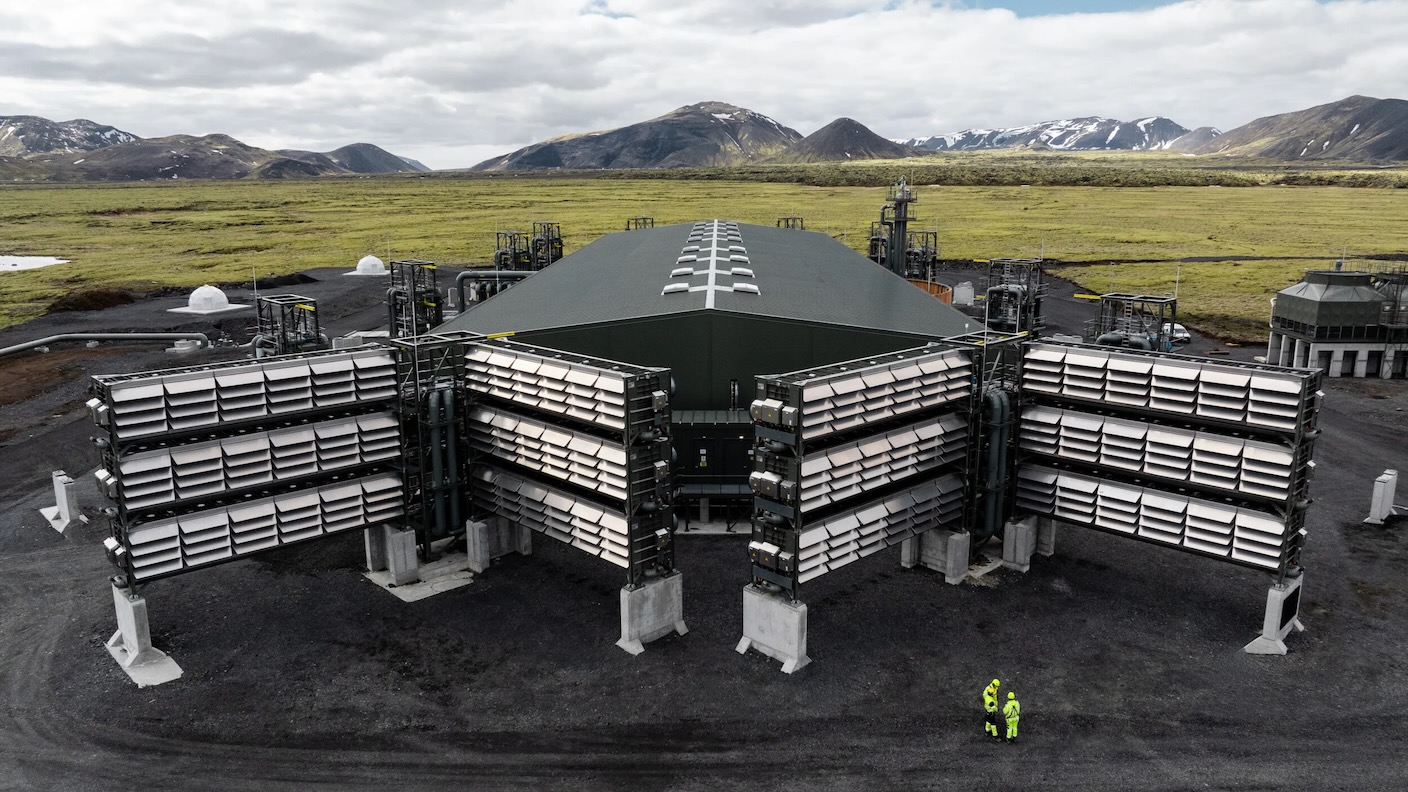
Pulling carbon dioxide out of the atmosphere is likely to be a crucial weapon in the battle against climate change. And now global carbon capture capacity has quadrupled with the opening of the world’s largest direct air capture plant in Iceland.
Scientists and policymakers initially resisted proposals to remove CO2 from the atmosphere, due to concerns it could lead to a reduced sense of urgency around emissions reductions. But with progress on that front falling behind schedule, there’s been growing acceptance that carbon capture will be crucial if we want to avoid the worst consequences of climate change.
A variety of approaches, including reforestation, regenerative agriculture, and efforts to lock carbon up in minerals, could play a role. But the approach garnering most of the attention is direct air capture, which relies on large facilities powered by renewable energy to suck CO2 out of the air.
One of the leaders in this space is Swiss company Climeworks, whose Orca plant in Iceland previously held the title for world’s largest. But this week, the company started operations at a new plant called Mammoth that has nearly ten times the capacity. The facility, also in Iceland, will be able to extract 36,000 tons of CO2 a year, which is nearly four times the 10,000 tons a year currently being captured globally.
“Starting operations of our Mammoth plant is another proof point in Climeworks’ scale-up journey to megaton capacity by 2030 and gigaton by 2050,” co-CEO of Climeworks Jan Wurzbacher said in a statement. “Constructing multiple real-world plants in rapid sequences makes Climeworks the most deployed carbon removal company with direct air capture at the core.”
Climeworks plants use fans to suck air into large collector units filled with a material called a sorbent, which absorbs CO2. Once the sorbent is saturated, the collector shuts and is heated to roughly 212 degrees Fahrenheit to release the CO2.
The Mammoth plant will eventually feature 72 of these collector units, though only 12 are currently operational. That’s still more than Orca’s eight units, which allows it to capture roughly 4,000 tons of CO2 a year. Adding an extra level to the stacks of collectors has also reduced land use per ton of CO2 captured, while a new V-shaped configuration improves airflow, boosting performance.
To permanently store the captured carbon, Climeworks has partnered with Icelandic company Carbfix, which has developed a process to inject CO2 dissolved in water deep into porous rock formations made of basalt. Over the course of a couple years, the dissolved CO2 reacts with the rocks to form solid carbonate minerals that are stable for thousands of years.
With the Orca plant, CO2 had to be transported through hundreds of meters of pipeline to Carbfix’s storage site. But Mammoth features two injection wells on-site reducing transportation costs. It also has a new CO2 absorption tower that dissolves the gas in water at lower pressures, reducing energy costs compared to the previous approach.
Climeworks has much bigger ambitions than Mammoth though. The US government has earmarked $3.5 billion to build four direct air capture hubs, each capable of capturing one million tons of CO2 a year, and Climeworks will provide the technology for one of the proposed facilities in Louisiana.
The company says it’s aiming to reach megaton-scale—removing one million tons a year—by 2030 and gigaton-scale—a billion tons a year by 2050. Hopefully, they won’t be the only ones, because climate forecasts suggest we’ll need to be removing 3.5 gigatons of CO2 a year by 2050 to keep warming below 1.5 degrees Celsius.
There’s also little clarity on the economics of the approach. According to Reuters, Climeworks did not reveal how much it costs Mammoth to remove each ton of CO2, though it said it’s targeting $400-600 per ton by 2030 and $200-350 per ton by 2040. And while plants in Iceland can take advantage of abundant, green geothermal energy, it’s less clear what they will rely on elsewhere.
Either way, there’s growing agreement that carbon capture will be an important part of our efforts to tackle climate change. While Mammoth might not make much of a dent in emissions, it’s a promising sign that direct air capture technology is maturing.
Image Credit: Climeworks

 canisgallicus