
C: Shutterstock
| John Mac Ghlionn | Comment Ireland
Homeless Elderly: a new norm and a new low for Ireland
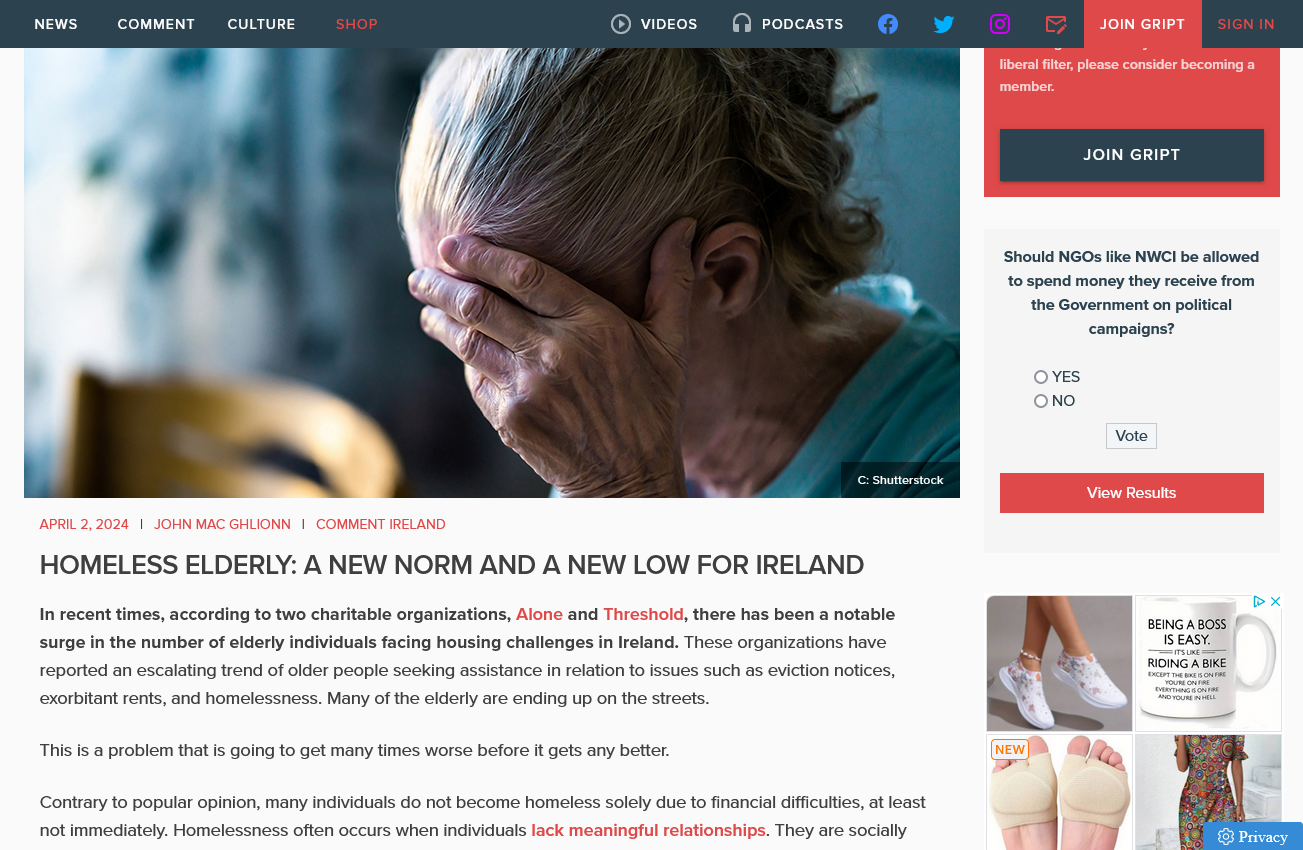
In recent times, according to two charitable organizations, Alone and Threshold, there has been a notable surge in the number of elderly individuals facing housing challenges in Ireland. These organizations have reported an escalating trend of older people seeking assistance in relation to issues such as eviction notices, exorbitant rents, and homelessness. Many of the elderly are ending up on the streets.
This is a problem that is going to get many times worse before it gets any better.
Contrary to popular opinion, many individuals do not become homeless solely due to financial difficulties, at least not immediately. Homelessness often occurs when individuals lack meaningful relationships. They are socially isolated, deprived of the oxygen needed to survive: human connection.
Family relationships serve as the primary safeguard against economic
Hardships — or at least they used to up until recent times.
The attack on the nuclear family originated in the United States. According to once esteemed outlets like The Atlantic and the Washington Post, the nuclear family was a grave mistake. More recently, in a piece for another once respected outlet, Business Insider, cultural critic Kelli Maria Korducki called the nuclear family a “blip,” urging readers in the US and beyond to embrace alternative forms of social units.
By alternative, of course, she means same-sex parents, single parents, co-parents, heterosexual couples who utilize donor sperm or eggs, and so forth — basically, anything but the actual version that has served us so well for centuries (more on this in a minute).
Sadly, more and more people, in the US and Europe, appear to agree with Korducki.
Ireland is no exception, where single parent families are on the rise. In truth, this has been the case for many years.
The reasons for the rise are myriad, but changes in societal norms, including belief in a higher power, have certainly played a part. Religious married couples tend to experience a greater sense of happiness and stability when compared to couples who are less religious.
“The nuclear family’s guise of self-sufficiency only barely conceals its toxic codependence with the market economy,” according to Korducki.
This is absolute nonsense.
Again, contrary to popular opinion, as the sociologist Brigitte Berger has shown, the roots of the nuclear family can be traced back to the 1700s, long before capitalism became a dirty word.
In her brilliant book, The Family in the Modern Age, Berger argues that the ordinary nuclear family proved to be highly adaptable to the evolving economic and political circumstances. In fact, the prevalent family structure in England played a significant role in the emergence of the Industrial Revolution and the subsequent prosperity experienced by nations in northwest Europe. In these Darwinian-inspired times, when only the fittest survived, the nuclear family provided a sense of solidarity and stability. Left to rely on their own resourcefulness, as Berger expertly demonstrates, family members worked in unison to plan for the future and cultivate middle-class values of hard work and saving.
A nuclear family was better equipped to nurture children that were both diligent and dutiful, the type of people ready to seize the opportunities presented by the Industrial Revolution, ultimately giving rise to the birth of middle class families.
Dismantle the nuclear family at your peril, because when one domino falls, others will inevitably collapse. One needn’t be a sociologist to see how the demise of traditional family structures and values have contributed to the aforementioned crisis among senior citizens.
Finally, it’s important to discuss the scourge of ageism. Virtually every other ism, from sexism to racism, is frowned upon. However, in Ireland, ageism still casts the nastiest of shadows,
A comprehensive survey by recruitment firm Matrix found that a significant portion of workers in Ireland – over half, to be exact – have encountered or observed discrimination in their work environment. Of all the forms of discrimination, age discrimination was the most referenced.
A majority of respondents stated that employees over 50 years old have limited chances for promotions compared to their younger counterparts. Additionally, nearly half of the participants mentioned that individuals aged 50 and above might find it challenging to switch jobs.
Let that sink in for a minute: in Ireland, 50 is now considered old.
The sad fact is that people are living longer but are experiencing ageism at a younger age.
Also, just because people are, on average, living longer, it doesn’t mean that their quality of life is of an acceptable standard.
As is clear to see, in Ireland, some people north of 50 (and south) are living lives where they face great difficulties. To compound matters, an increasing number of elderly individuals are ending up on the streets.
What are our elected leaders doing about it?
Very little, it seems. Instead of prioritizing emergency housing for Irish citizens, they continue to put the needs of migrants first. By opening the door to so many foreigners, they are closing the door on arguably the country’s most vulnerable demographic.
This is just one of the reasons why, as mentioned, things will likely get many times worse before they get better.
Posted in Comment Ireland

 canisgallicus