
March 25, 2024
9 min read
Why Isn’t Dental Health Considered Primary Medical Care?
Ailments of the mouth can put the body at risk for a slew of other ills. Some practitioners think dentistry should no longer be siloed
By Lola Butcher & Knowable Magazine
The patient’s teeth appeared to be well cared for, but dentist James Mancini did not like the look of his gums. By chance, Mancini knew the man’s physician, so he raised an alert about a potential problem — and a diagnosis soon emerged.
“Actually, Bob had leukemia,” says Mancini, clinical director of the Meadville Dental Center in Pennsylvania. Though he wasn’t tired or having other symptoms, “his mouth was a disaster,” Mancini says. “Once his physician saw that, they were able to get him treated right away.”
Oral health is tightly connected to whole-body health, so Mancini’s hunch is not surprising. What is unusual is that the dentist and doctor communicated.
Historically, dentistry and medicine have operated as parallel fields: Dentists take care of the mouth, physicians the rest of the body. That is starting to change as many initiatives across the United States and other countries work to integrate oral and whole-body care to more effectively tackle diabetes, cardiovascular disease, joint replacements and many other conditions. The exact relationship between health of mouth and teeth and physical ailments elsewhere in the body is not well understood — and in some cases, is contentious — but experts agree there are links that should no longer be overlooked.
In recent years, dental hygienists have started working in medical clinics; physicians and dentists have started a professional association to promote working together; and a new kind of clinic — with dentists and doctors under one roof — is emerging.
“We are at a pivotal point — I call it the convergence era — where dentistry is not going to be separated from overall health for much longer,” says Stephen E. Thorne IV, founder and CEO of Pacific Dental Services, based in Irvine, California. “Dentistry will be brought into the primary care health-care team.”
Sick mouth, sick body
The list of connections between oral health and systemic health — conditions that affect the entire body — is remarkable. For starters, three common dental issues — cavities, tooth loss and periodontal disease — are all associated with heart disease, the leading cause of death in the United States. “To me, the number one hidden risk factor for the number one killer in our country is oral health,” says Ellie Campbell, a family physician in Cumming, Georgia, and board member of the American Academy for Oral Systemic Health, founded in 2010 to increase awareness of how oral and whole-body health are related.
Curated by Our Editors
- Ancient Sawfish Help to Illuminate Our Teeth’s Scaly OriginsDaniel Leonard
- Synthetic Enamel Could Make Teeth Stronger and SmarterJoanna Thompson
- Why We Have So Many Problems with Our TeethPeter S. Ungar
- Fetal Scans and Mammograms–There’s a Groupon for ThatLauren Weber & KFF Health News
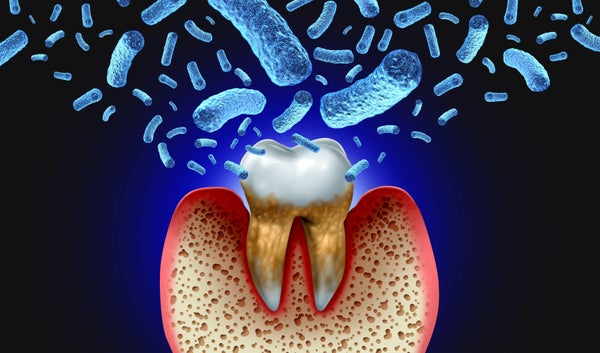
Periodontal disease, infection and inflammation of the gums and bone that support the teeth, is the main culprit. Nearly half of adults 30 and older have periodontal disease; by age 65, the rate climbs to about 70 percent. In the early stages, called gingivitis, gums are swollen and may bleed. Periodontitis, a more serious condition in which gums can pull away from the teeth, is the sixth most common human disease.
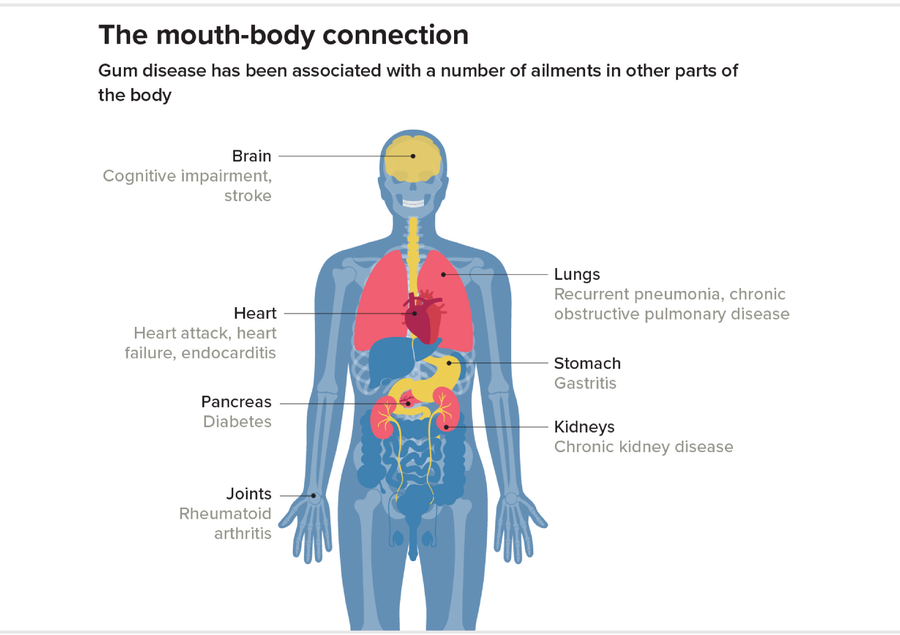
Periodontitis is associated with a slew of systemic ills: heart attacks, strokes, heart failure, diabetes, endocarditis, chronic kidney disease, recurrent pneumonia, chronic obstructive pulmonary disease, gastritis, rheumatoid arthritis, cancer and cognitive impairment.
Bad habits, including tobacco use, alcohol consumption and high-sugar diets, are implicated too. They raise the risk for cavities and most oral diseases, and are also linked to ills such as cancer, chronic respiratory disease and diabetes.
Such connections were apparently lost on officials at the University of Maryland in 1837, when the university rebuffed a proposal from two physicians to teach dentistry to the school’s medical students. At the time, medicine wanted nothing to do with dentistry, which was practiced by unregulated and inadequately trained itinerants, says medical and dental historian Andrew I. Spielman, a dentist and oral surgeon at the New York University College of Dentistry. “There were a lot of charlatans,” he says. “They had a very bad reputation.”
The dismissal prompted the rejected physicians, Horace Hayden and Chapin Harris, to establish the world’s first dental school, the Baltimore College of Dental Surgery. Today, dentistry is a highly regulated profession, and the United States has 73 accredited dental schools.
Despite their disparate training, both doctors and dentists are aware that mouth health is important to whole-body health, Campbell says. “Ask a family practice doctor and they will say ‘Oh yeah, if the patient has diabetes, they’re going to have bad teeth and gums, and I can never get their diabetes better until the dentist fixes their gums,’” she says. “And the dentist is going to say, ‘Well, I’ll never get their gums better until the primary care doctor gets their sugar under control.’”
Mancini, the Pennsylvania dentist, says dentists often are asked to examine a patient’s mouth before physicians will proceed with certain treatments. “Physicians know any infection in a patient who’s being treated for cancer could be very much life-threatening,” he says. “The orthopedic guys are now sending all of their patients to the dentist for the same reason.”
Hurdles to holistic care
But working together to improve a patient’s health is not as simple as it might seem. A decade ago, the federal government hired the National Network for Oral Health Access to run a pilot program merging oral and primary health-care centers. The network’s dental consultant, Irene Hilton, a dentist with the San Francisco Department of Public Health, said three barriers to integration became clear.
The fragmented way that health care and dental care are paid for is one of them. While more than 90 percent of Americans have health insurance, only 77 percent of US adults ages 19 to 64 have dental coverage, which typically is sold separately from health insurance. The nation’s largest insurer — the federal Medicare program — generally does not cover dental services, and nearly half of Americans 65 and over have no dental coverage.
Sign Up for Our Daily Newsletter
Email Address

 canisgallicus