
Support the Guardian
Fund independent journalism with €10 per month Support us
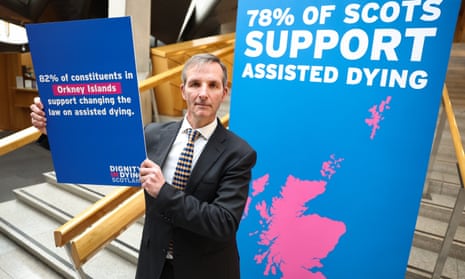
‘Politicians are catching up with the public’: MSP Liam McArthur, who tabled the assisted dying bill on Thursday. Photograph: Jeff J Mitchell/Getty Images
Bill tabled in Scotland could legalise assisted dying for terminally ill adults
If law is passed Scotland would become first part of UK to offer terminally ill people assistance to end their lives
Libby Brooks Scotland correspondentThu 28 Mar 2024 12.40 CETLast modified on Thu 28 Mar 2024 13.01 CET
Scotland could become the first part of the UK to offer terminally ill adults assistance to end their lives if Holyrood approves a new bill.
The Scottish Liberal Democrat MSP Liam McArthur, who tabled the assisted dying for terminally ill adults (Scotland) bill on Thursday, said “politicians are catching up with where the public has been for some time” as extensive polling for Dignity in Dying Scotland found 78% of respondents supported legalisation.
Publishing the bill in the Scottish parliament, McArthur said: “Our current laws on assisted dying are failing too many terminally ill Scots at the end of life. Too often, and despite the best efforts of palliative care, dying people are facing traumatic deaths that harm both them and those they leave behind.
“This bill contains robust safeguards, similar to those which have been safely and successfully introduced in countries such as Australia, New Zealand and the United State, where they continue to enjoy strong public support.”
McArthur’s bill will be the fourth attempt to introduce assisted dying legislation at Holyrood and is tightly drafted to assuage concerns that it will place pressure on vulnerable people who fear being a burden on their loved ones. It is still expected to be fiercely opposed by disability rights and faith groups.
It is only open to adults who have been resident in Scotland for at least a year and who have been assessed by two independent medical practitioners to be terminally ill, of sound mind and under no pressure. Applicants must administer the life-ending drugs themselves.
Addressing the depth of concerns for human rights on both sides of the debate, Fraser Sutherland of the Humanist Society Scotland, which has supported the development of the bill, pointed out that the proposed law only applies to terminally ill people, so disabled people would not be eligible.
“At this point, the ‘slippery slope’ argument is often used to suggest it is only a matter of time before the law is expanded. But, contrary to certain media narratives, we have seen many assisted dying laws similar to Liam McArthur’s bill (ie those that apply only to terminally ill people) introduced without any subsequent expansion”.
But a letter sent to MSPs from a coalition of disability rights groups, including the Better Way Campaign, Disability Equality Scotland and Inclusion Scotland, urges MSPs to vote against the bill.skip past newsletter promotion
Sign up to First Edition
Free daily newsletter
Our morning email breaks down the key stories of the day, telling you what’s happening and why it matters
Enter your email address
“In an era when long-term conditions are lasting for longer, and health and social care are becoming increasingly expensive, vulnerable groups are specifically threatened by the future consequences of assisted dying legislation. It is not difficult to imagine that an individual’s judgment that ‘my life is not worth living’ can morph into others’ perception that ‘his or her life is not worth living’.”
Dr Gillian Wright, a former palliative medicine registrar now representing Our Duty of Care, an alliance of healthcare professionals opposing assisted dying, said:
“The primary danger of assisted suicide is that individual lives are devalued by society because they are ill, disabled, confused or that their contribution to society is perceived to be minimal. The secondary danger is that terminally ill and disabled individuals may begin to devalue themselves because of the burden that they perceive they are to society.”

 canisgallicus