
Ukraine: How the war is poisoning the environment
Julia VerginPublished 03/07/2023Published March 7, 2023last updated 02/22/2024last updated February 22, 2024
Russia’s Ukraine war is not only taking a toll on people’s lives, it’s also been devastating for the environment — the long-term effects are hard to judge.
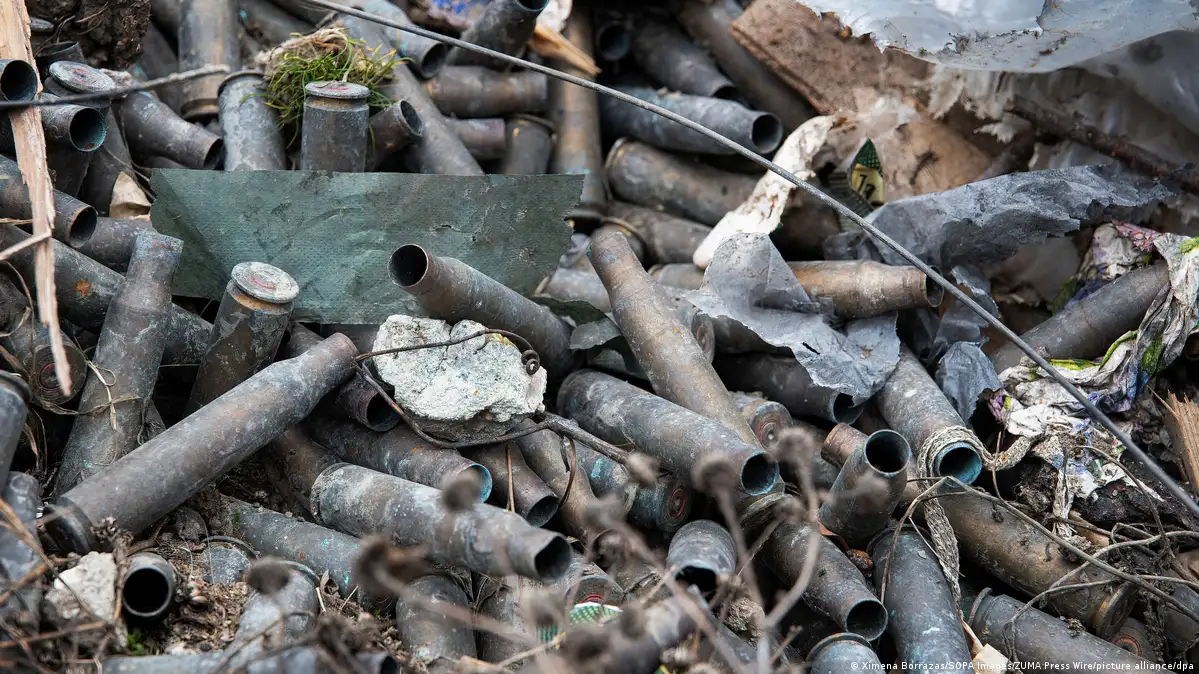
The Russian war on Ukraine started two years ago. And there is no end in sight. But even if the soldiers stopped firing their guns and stopped dropping bombs today, if there were no more explosions at refineries and other industrial facilities — the people of Ukraine would still not be safe.
Research suggests the effects of the war on people, wildlife and the environment will last long into the future.
A study into the environmental ramifications of the conflict suggests that the first year-and-a-half of the war alone was responsible for an extra 150 million tons of CO2 emissions — to compare, that’s the same amount of CO2 that Belgium emits per year.
Those are the conclusions of the Initiative of GHG Accounting of War, a group of experts who have been monitoring the environmental damage caused by the war. They presented their findings in December 2023 at a UN Environment conference in Dubai.
A war on people and the environment
A new analysis by the US-Ukrainian research team presents further data: Landscape destruction, shelling, forest fires, deforestation and pollution have affected 30% of Ukraine’s protected areas.
The team, which is led by Daniel Hryhorczuk, Professor Emeritus at the Institute for Environmental and Occupational Safety and Epidemiology at the University of Illinois School of Public Health in the US, fears that Russia’s occupation of the Zaporizhzhia nuclear power plant and the destruction of the Kakhovka dam will lead to lasting ecological catastrophe.
In addition, they say the local air, water and soil are contaminated with chemicals on a large scale, and that 30% of Ukraine is contaminated with landmines and unexploded ordnance.
Once those chemicals get into the soils and ground water, it may only be a matter of time before they are transmitted to humans via plants, animals, and drinking water.
At least, that is what toxicologists say could happen. They are not entirely sure how the environment will deal with these toxic substances, or what effect they could have on humans.
TNT is carcinogenic
Among the most dangerous elements in munitions are the explosives themselves, and the heavy metals. That includes Trinitrotoluene, better known as TNT, a nitroaromatic compound known for its explosive power.
“We know through experiments on rats and mice that TNT is toxic,” said Edmund Maser, director of the Institute for Toxicology at the University Clinic in Kiel, Germany.
Maser researches the effects of the munitions that were dumped in the German part of the North and Baltic Seas after World War II — 1.6 million tons of munitions are rusting away there.
Toxicologists have also observed in the Seas that the TNT released from the dumped munitions is harming animals in the surrounding area: “TNT compromises the ability of marine life to reproduce, grow, and develop,” said Maser. “We also know from these studies that TNT and other explosives are carcinogenic.”
Mercury, arsenic, and lead destroy cells
Some heavy metals, such as arsenic and cadmium, are carcinogenic.
“Above all, the detonators contain heavy metals, such as mercury in the form of a fulminate that makes the TNT explode faster,” said Maser. A fulminate acts as a kind of catalyst.
As a heavy metal, mercury is also damaging for nerve cells: “It can lead to birth defects in unborn babies,” said Maser.
Lead has similar effects and can cause developmental disorders or miscarriages.
Kateryna Smirnova, a researcher at the Sokolovsky Institute for Soil Science and Agrochemistry Research at Ukraine’s National Academy of the Sciences, said that soil samples from Kharkiv — one of the major battle sites in the east of the country — had already shown higher concentrations of lead and cadmium.
Smirnova’s colleague, Oksana Naidyonova, a microbiologist at the Sokolovsky Institute, explained that heavy metals have a negative effect on bacteria in the soil.
“They inhibit the development of plants and the supply of micronutrients, which leads to physiological defects and reduces their ability to withstand disease,” Naidyonova said.
Ukraine war: Researchers on the run
But the chemicals will not necessarily stay in the soil. TNT, for example, could be carried away by the wind and distributed farther afield, said Maser. Rain could even reach some of the substances found deeper in the ground.
“The elements may then get into surface waters and contaminate streams, rivers, and lakes,” he said.
A toxic cycle
If animals ingest the chemicals, those chemicals can enter the food chain and eventually become dangerous for humans as end consumers, said Maser.
And if the rains run off, allowing the chemicals to seep into the ground water, “that would mean drinking water was at risk of becoming contaminated,” Maser added.
If the water becomes contaminated this way, plants could consume mercury and other chemicals. If these plants happen to be crops like wheat or vegetables, then the same chemicals would end up on our dinner plates.
Environmental damage in the billions
The example of Ukraine illustrates the immense costs of the destruction caused by war. According to this latest analysis, the war in Ukraine has caused environmental damage of more than $56.4 billion (€52 billion).
Hryhorczuk’s team is calling for the environmental consequences of all armed conflicts to be investigated and for more effective measures to be taken to protect the environment during war. They also want those responsible for damaging the environment during war and those who instigate a war to be held to account.
This article was originally published in German.

 canisgallicus