
- CAREER COLUMN
- 14 June 2023
How my bipolar diagnosis changed my scientific career
I spent more than a year in a manic state, burning out for the sake of my job. Here’s how I found balance again.
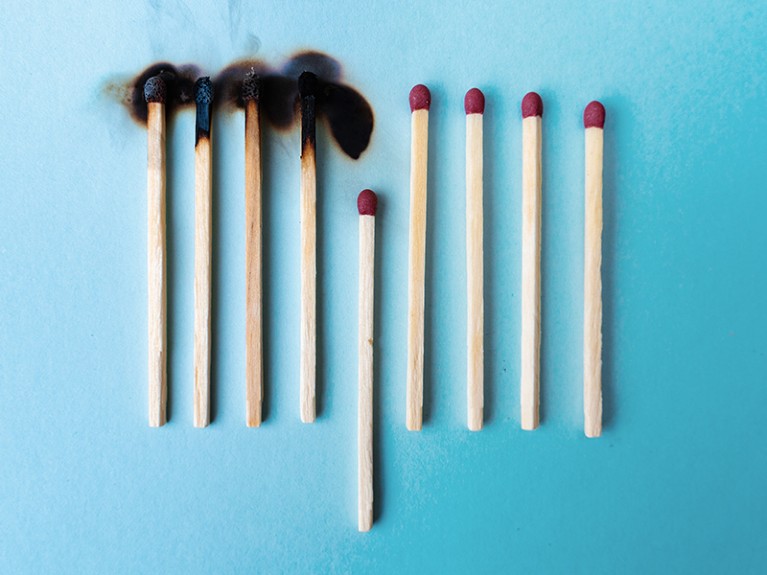
For tenure-track faculty members, the hypomania (‘mania lite’) associated with bipolar disorder might have sparked their passion for scientific inquiry, and, perhaps, even seemed to speed their career success. That was certainly briefly the case for me.
When you’re hypomanic, “connecting the dots” comes easy. Creating a testable, overarching model for a grant submission becomes a labour of love. Doing deep dives into the literature to extract support for the model is aided by hyperfocus and a drastically reduced need for sleep.
The steps needed to achieve promotion — such as demonstrating productivity through grants awarded and manuscripts published, and developing a national and international reputation by being invited to present research or serve on grant-review panels, all while maintaining excellence in teaching and service — are ideally suited to the egocentric ego-driven, charismatic, superhuman state that someone with hypomania finds themselves in. Yet, in bipolar disorder, hypomania can lead to mania, a completely dysfunctional state, which is what happened to me.Feeling lonely in research? You’re not alone
I can’t tell you the exact day that my mania started. But, sometime in 2016, a perfect storm of external stressors over several months spiralled me into a manic episode. This ended abruptly on 20 September 2017, just after I submitted my dossier for promotion to associate professor with tenure — together with what, in my words to a friend and colleague, was “the best grant application that’s ever been written”. (It wasn’t: grandiosity is a symptom of mania.)
That day, I experienced a shock in my personal life that made me question my understanding of reality. In almost a single moment, I realized that my recent thoughts and behaviours were most probably just symptoms of undiagnosed bipolar disorder.
From high to low
On the day ‘Manic Michelle’ disappeared, I was left easily overstimulated and incapable of doing any higher-order cognitive functions for weeks. The music at my gym was too loud. I couldn’t look at bright lights. Dedicating brainpower to a task as simple as answering e-mails filled me with dread. I had to cancel projects that I had agreed to do and I felt generally overwhelmed and depressed. I had no idea how long it would take for me to be myself again, or whether it would ever happen.
I already had a therapist. She agreed with my self-diagnosis and gave me behavioural strategies to survive while I waited almost two months for a psychiatric appointment.The good side of science: why I tweeted 31 reasons to love your career
It was such a relief to finally get to tell the psychiatrist my story — the good, the bad and the ugly — and have her reassure me that my disorder could be treated and that I was not alone. According to David Miklowitz, author of The Bipolar Disorder Survival Guide: What You and Your Family Need to Know, bipolar disorder affects between 1 in 25 and 1 in 50 US adults. Not only that, but my psychiatrist told me she had at least ten patients with similar external stressors.
Within one week of starting to take a mood stabilizer prescribed by my psychiatrist, the rapid cycling that I’d been experiencing between depression and mania stopped, but I was left stuck in a pit of despair. Because classical antidepressants can trigger mania, my doctor added an atypical antipsychotic, a class of drug that is extremely effective for bipolar depression. She also diagnosed me with, and prescribed a stimulant for, attention deficit hyperactivity disorder (ADHD): a common comorbidity, especially in women. (Stimulants can help to boost concentration among some people with ADHD.) My moods then normalized, and I finally experienced what it must be like to be neurotypical. It was like two switches in my brain had been switched the opposite way for my entire life, and, oddly enough, had compensated fairly well for each other — until they didn’t.
Day-to-day help
To truly advance in my career path, however, I knew I needed extra support to ameliorate the stress that often triggers a bipolar episode. Although I never imagined this as an undergraduate, as a tenure-track faculty member in the department of medicine at the University of Wisconsin–Madison, I spend most of my time reading, writing and reviewing grant proposals and manuscripts. I also have to prepare lectures and teach graduate and medical students, as well as serve on university, regional and national committees and grant-review panels.Are you a postdoc working in academia or industry? Share your career experiences with Nature
****Yet, all these tasks include a considerable amount of administrative work — such as completing Doodle polls, scheduling meetings, making sure staff are up-to-date on their trainings, and innumerable other tasks that I was struggling to keep up with. I spoke with my division chief and division administrator, who helped me go about the process of speaking with human resources, to officially request reasonable accommodations for my disability.
I was granted the support of a part-time administrative assistant, allowing me to focus my energy on only the higher-order aspects of my research, teaching and service duties. I was also given approval to work from home for up to two days every two weeks, to reduce stress, and to take family or medical leave if I ever needed to do so.
In 2020, when the stress of the COVID-19 pandemic began to destabilize my mood, being able to take three months off while my job was protected was a godsend. I felt badly about having to back out of projects and committee assignments that I’d committed to, but was assured by colleagues that they would survive without me, allowing me to focus completely on my recovery so that I could come back to work with dedication and passion.
Moving on up
Since my diagnosis, these accommodations have helped me to get my research programme back on track and start moving up in leadership: a career aspiration I’d had since my undergraduate research assistantship at Michigan State University in East Lansing. Now, I am co-director of the Islet Biology Core, part of the University of Wisconsin–Madison’s Comprehensive Diabetes Center. It’s a leadership role that meshes perfectly with my overarching research programme to identify and validate innovative therapeutic targets for the β-cell dysfunction of diabetes.How to organize a conference that’s open to everyone
I am ‘out’ with my bipolar disorder and ADHD diagnoses, and one of my personal passions is advocating for destigmatization of mental-health disorders. To my knowledge, I have not experienced any professional discrimination based on my disorder. I am a valued and respected contributor to the mission of my university’s school of medicine and public health, and to the scientific community.
In 2019, I replied to a Tweet (which has since been deleted) about how faculty members shouldn’t be afraid to disclose their bipolar diagnosis to receive reasonable accommodations; for me, these have been crucial in being able to stay in and advance upwards through my career.
Many of the responses that I received, however, said that being upfront about such a disorder was the worst thing a person could do. It was then that I realized, unsurprisingly in hindsight, that my experiences were not everyone’s experiences. These negative responses are distressing, because refusing to provide reasonable accommodations for and discriminating against an individual with a disability is not only harmful and short-sighted, but, in the United States and the United Kingdom, illegal.
Workplace support
For those with bipolar disorder who need help to stay in their careers but are wary about disclosing their diagnosis, remember that you might be entitled to reasonable accommodations and job protection — although that depends, of course, on the legal situation in the country you’re based in.Collection: Diversity and scientific careers
My first step was to speak with my university’s disability coordinator, who acted as an intermediary between myself, my department’s administrative staff and my physician. My physician provided the coordinator with the required documentation on my disability, how it affects the performance of my essential duties and what sorts of accommodation would help me to succeed.
The disability coordinator then wrote to my department’s human-resources office, stating that I needed these reasonable accommodations because of a disability, without revealing what that disability was. A strong support system of clinicians, colleagues, family, friends and the bipolar-disorder community also helped throughout this process and gave me the courage to fully disclose my disability in my professional sphere: something that I felt was necessary if I wanted to be an advocate for others. I’ve gained immense satisfaction from this decision, but I know that making such a decision is something personal that only you can do.
In relaying my own experience, my greatest hope is that departments and institutions will see that providing reasonable accommodations, and modelling a non-discriminatory workplace, provides them with tangible benefits — allowing highly intelligent, passionate, creative, innovative and dedicated faculty members to use their innate skills to advance overarching programmatic missions.
Finally, if you see yourself in me, you are not alone.
****Trinity College Dublin did assign a PA to me but only for 1 hour per week. This was a real positive but unfortunately the anxiety fed into the mania of Bipolar and I am an example of a person where the safety net failed.
doi: https://doi.org/10.1038/d41586-023-01967-1
This is an article from the Nature Careers Community, a place for Nature readers to share their professional experiences and advice. Guest posts are encouraged.

 canisgallicus